
How to Turn a Winger’s Strengths Into Centre-Back Decisions
Use a five-stage progression to build pre-reception scanning, two-way distribution, pivot cooperation and decisions against active defenders.
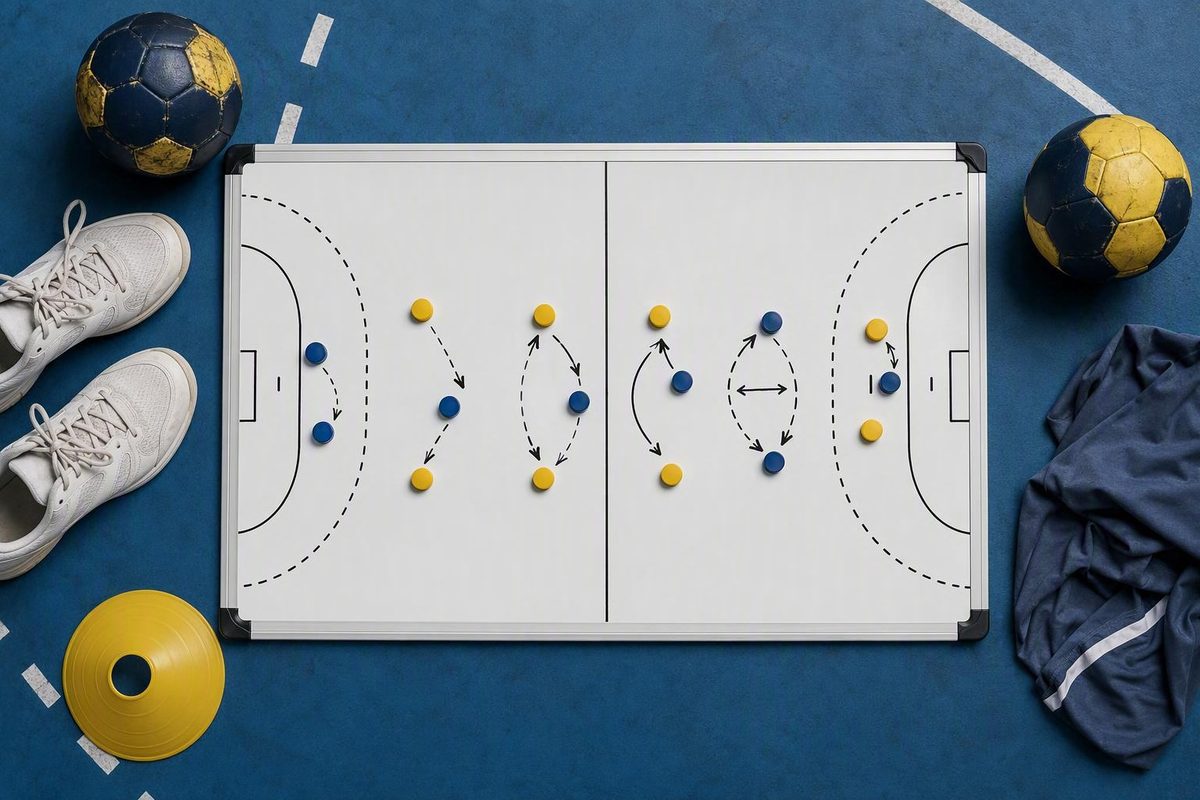
Moving from wing to centre back in handball means shifting from finishing and creating width on the defensive flank to organising the attack from the middle. Keep the acceleration, timing and off-ball awareness developed on the wing, but add pre-reception scanning, accurate distribution in both directions, cooperation with the pivot and backs, and decision-making under pressure.
The short answer: the job changes from finishing wide to organising centrally
The wing normally starts near the corner and attacks the outside of the defence. The centre back is the back-court playmaker, usually operating centrally around the nine-metre line. The IHF teaching manual describes the centre back as the playmaker, with the left and right backs completing the back-court line.
| Requirement | Wing | Centre back |
|---|---|---|
| Starting area | Wide, near the corner | Central, commonly near nine metres |
| Primary attacking job | Preserve width and finish from the flank | Organise, distribute and create advantages |
| Time on the ball | Often receives near the end of a phase | Receives repeatedly throughout the phase |
| Passing directions | Commonly back inside or along the goal-area line | Left, right, into the pivot, wide or back to a crossing player |
| Shooting emphasis | Narrow-angle finishes and fast breaks | Central drives, back-court situations and passing-versus-shooting choices |
| Off-ball movement | Holds width, times runs and attacks behind outside defenders | Supports possession, crosses, changes position and rebalances the attack |
| Teammate relationships | Works most closely with the adjacent back | Connects both backs, both wings and the pivot |
The largest change is not simply receiving more passes. A centre back must notice how the central defenders move, decide whether to accelerate or reset the attack, and connect teammates without allowing the phase to become static. That can mean changing the point of attack, releasing a wing, feeding the pivot or moving a defender without making the final pass.
Every reception creates decisions before and after the catch. Before receiving, the player must identify the defensive shape and available support. After receiving, the player must respond to any defender, pivot or teammate who has moved. A memorised pattern can establish spacing, but it cannot provide the answer when a defender steps out or the intended lane closes.
Treat the progression below as a practical development framework rather than a scientifically validated conversion programme. The available evidence describes positional roles, coaching exercises and grouped positional demands; it does not establish a drill sequence that guarantees a permanent move from wing to centre back.
Keep these wing qualities—and build the missing centre-back skills
Do not try to turn the winger into a completely different athlete. Repurpose the qualities that already work:
- Acceleration and changes of pace: use them to draw a central defender forward, attack a gap or create momentum before passing.
- Agility and direction changes: apply them to central one-against-one actions, crossings and recovery after releasing the ball.
- Transition running: remain a threat in the first and second waves, then arrive under control to organise positional attack.
- Timing: use an understanding of wing runs to release wide teammates before the outside defender closes the lane.
- Off-ball awareness: transfer familiar run timing into crossings, positional exchanges and support behind the ball.
- Knowledge of flank defenders: recognise when central circulation has drawn an outside defender far enough inward to open the wing pass.
The missing skills require deliberate practice. The player must scan before receiving, catch while moving, open the body to see both sides and pass accurately left or right without always resetting the feet.
Centre back is also a cooperation role. The player must learn the preferred timing and receiving lines of both adjacent backs, understand when the pivot wants an early feed, and recognise when a pivot screen creates a driving lane rather than a passing opportunity. The goal is not to collect individual assists but to improve the next action available to the team.
Back-court shooting should enter the programme too. Move some repetitions away from narrow wing angles and towards central receptions followed by a shot fake, drive, pass or shot. Height, arm strength and shooting power can influence how a player is used, but they are considerations rather than fixed eligibility requirements.
Watch for five common early errors:
- Receiving without scanning and discovering the options too late.
- Holding the ball until the defence has recovered its shape.
- Forcing a difficult pivot or cross-court pass because it was the planned action.
- Continuing a rehearsed pattern after the defensive cue has changed.
- Drifting into a familiar wide area and leaving nobody to organise centrally.
Correct the decision as well as the execution. A technically imperfect pass selected at the right moment often gives the coach a clearer development target than a perfect pass delivered to the wrong option.
Use a five-stage progression from clean technique to live decisions
These are adaptable stages, not a fixed week-by-week schedule. A player may complete several in one session, return to an earlier stage for technical work and then finish with live play.
Stage 1: Central passing foundations
| Setup | Centre-back purpose | Progression | Observable success criterion |
|---|---|---|---|
| Coach-selected number of receivers positioned left, right and centrally; no defenders | Receive while moving towards the ball, open the body and distribute in several directions | Increase approach speed, add another ball or call the destination late | The player scans before receiving, catches without stopping and passes accurately without turning fully towards one option |
Begin slowly enough to establish body position. The player should approach the ball rather than wait flat-footed, receive with a view of both sides and deliver ahead of a moving teammate. Increase speed only while that shape remains stable.
The number of receivers is adjustable. A small group can use three passing targets and rotate frequently; a larger group can run two identical stations rather than placing players in long queues.
Stage 2: Pass and change position
| Setup | Centre-back purpose | Progression | Observable success criterion |
|---|---|---|---|
| Players occupy wing and back positions and pass through LW–LB–CB–LB–LW before repeating from the other side | Give the former winger repeated central receptions and immediate redistribution tasks | Rotate passers to the next position and reverse direction on the coach’s signal | The player reaches the central slot on time, receives in motion and moves after passing without closing a teammate’s space |
This sequence appears in an EHF-hosted collection of wing–back cooperation exercises. Do not let it become choreography with heads down. Reverse the direction, change the starting side or ask the centre back to identify the next receiver before the pass arrives.
Stage 3: Crossings and exchanges
| Setup | Centre-back purpose | Progression | Observable success criterion |
|---|---|---|---|
| Six attackers start at LW, LB, CB, RB, RW and pivot; the CB begins with the ball and rehearses a crossing with one wing | Learn the spacing and timing of a wing–centre exchange while retaining links to the back and pivot | Start unopposed, then add a passive defender instructed to step out, stay compact or block one lane | The centre back clears the exchanged space, keeps the attack balanced and chooses a continuation that matches the defender’s position |
For one reproducible version, have the wing move inward towards the centre back. The centre back releases the ball and clears towards the space vacated by the wing. The ball carrier then continues through the adjacent back, returns the ball into the exchange or uses the pivot, depending on the coach’s cue. Reset after the continuation and rotate the developing player through the central starting position.
Once the basic spacing is stable, vary the action with piston movements, shot fakes, return passes and inside runs. A passive defender must have a defined task rather than standing as decoration. Tell the defender to step towards the ball, remain compact or close a named lane so the attacker has a visible cue to read.
Stage 4: Constrained decisions
| Setup | Centre-back purpose | Progression | Observable success criterion |
|---|---|---|---|
| An adjustable possession area using an overload such as 4v2 or 6v3 under normal ball-holding and movement restrictions | Scan, support the ball and change the point of attack under time pressure | Reduce the area, require circulation through the centre back or make possession change immediately after a turnover | The player offers a useful angle before receiving and finds the free teammate without unnecessary dribbles |
A 10-by-10-metre area is a practical starting example, not a validated or mandatory dimension. Adjust it to the players’ age, technical level and available hall space.
The intended coaching rationale is simple: an attacking overload should create a free teammate, allowing the coach to observe whether the developing centre back finds that option early. With fewer players, use 3v1 and rotate the defender frequently. With a larger group, operate two small areas instead of creating a queue.
Stage 5: Active team scenarios
| Setup | Centre-back purpose | Progression | Observable success criterion |
|---|---|---|---|
| Attack against active defenders, beginning with a coach-defined combination | Initiate the attack, adapt when the defence changes and organise the response to a turnover | Change the defenders’ instructions, add a coach-set time limit or start from different restart situations | The player calls the action clearly, changes it when required and reacts immediately when possession changes |
The first action can be prescribed; the continuation should not be. For example, require a crossing but allow the defenders to switch, stay compact or step out. The centre back must then choose from the options available within the team’s attacking system.
Position rotation and overloads make the progression realistic for a mixed-ability club squad. One group can work on clean passing while another runs a small possession game, then swap. Meaningful repetitions matter more than academy-sized player numbers.
Coach the decision before the pass
Give the player one repeatable routine before every central reception:
- Scan the central defenders and pivot space.
- Locate both adjacent backs.
- Check the available wings and whether either outside defender has narrowed.
- Move towards the pass with a body position that preserves more than one option.
The exact response depends on the team’s attacking system. Coaches should define the available options rather than present one answer as correct in every situation.
| What the player sees | Coach-defined options | Likely poor response | Review question |
|---|---|---|---|
| Central defender steps out | Pass behind the defender, use the pivot, cross or attack the adjacent gap | Dribble into contact after the gap has closed | Which space opened when the defender left the line? |
| Defence remains compact | Circulate quickly, threaten from range, begin an exchange or reposition the pivot | Hold the ball while waiting for an obvious opening | How could you make one defender move? |
| Teammate begins a crossing | Pass and clear space, retain the ball if the combination allows it, or use the vacated lane | Follow the pattern while watching only the crossing player | What did the second defender do? |
| First passing lane closes | Reset, reverse play, drive into a new lane or use safe support behind the ball | Force the planned pass through an occupied lane | Which option remained available? |
A good centre-back decision does not have to produce a goal or assist. It may preserve possession, move a defender, improve spacing or give the next receiver an advantage. Judge whether the choice improved the phase, not merely whether the final shot went in.
Communication should be short and timely. Name the combination before teammates need to move, alert the next receiver and call the immediate transition response after a turnover. The coach should also standardise the team’s vocabulary; several names for the same crossing create avoidable hesitation.
During feedback, ask: “What did you see before you received?” Listen before discussing pass mechanics. If the player recognised the correct cue but executed poorly, the main task is technical.
Adjust shooting and conditioning without inventing centre-back benchmarks
Research associates wings with more fast-break involvement and backs, considered as one combined group, with more throws. A systematic review of elite competition found positional differences but did not separate centre backs from left and right backs. Its results therefore cannot be treated as centre-back-specific requirements or transferred directly into standards for a youth or recreational player (systematic review of physical demands in elite handball).
The physical implications for an individual centre back should be treated as coaching synthesis, not as measured proof that every centre back has the same workload. Central attacking play commonly involves short accelerations, decelerations, changes of direction and technical actions in confined spaces, but actual demands vary with playing time, defensive assignment, rotation strategy and the team’s tactical model.
Nor would a lower result in one running measure make a back-court role easier. Organising possession adds passing pressure, repeated tactical choices and responsibility for maintaining the structure of the attack.
Shift part of the player’s shooting practice towards situations that resemble the new role:
- Receive centrally while moving forwards.
- Threaten a shot before choosing between pass, drive and release.
- Shoot after a crossing or return pass.
- Use a fake to move the defender before attacking the next space.
- Continue the phase with a pass when shooting is not the best choice.
Do not prescribe a universal running volume, strength target or shooting range. Conditioning should reflect the player’s age, current ability, playing time, injury history, defensive work and tactical responsibilities. Preserve useful sprint exposure from wing training while adding coach-appropriate accelerations, decelerations, direction changes and technical decisions under fatigue.
Introduce the role in matches and track observable progress
Use short, planned centre-back rotations before making the switch permanent. Tell the player which phase or minutes they will play centrally, what they are authorised to call and what the coach will evaluate.
Use a simple scorecard across several live phases:
| Behaviour | What to record |
|---|---|
| Scans before reception | Consistent, occasional or absent |
| Passes under pressure | Accurate and timely, accurate but late, or inaccurate |
| Avoidable turnovers | No scan, forced pass, poor control or unclear communication |
| Change of attack | Whether possession can be moved effectively from one side to the other |
| Coordination | Timing with the pivot and both backs |
| Tempo | Appropriate acceleration, circulation or reset |
| Communication | Early, clear and understood |
| Possession change | Immediate transition response or delayed reaction |
Score the decision separately from the outcome. A correct pass can be dropped by a teammate, while a poor choice may occasionally end in a goal. Review the cue, available options and timing before judging the result.
The coach must also define the player’s authority. Does the centre back call set plays? May the player abandon or change a combination? Are they expected to slow the game after several rushed attacks? Unclear authority can make a hesitant player appear tactically weak when the actual problem is role ambiguity.
Separate attacking and defensive selection. Moving to centre back in attack does not automatically mean defending centrally. State whether the player will take an outside, half or inside defensive assignment, then train the transition route required to reach that position.
Readiness should be based on repeated behaviour against active defenders within the team’s system. Permanent conversion or continued wing–centre rotation is then a coaching decision shaped by team needs and observed performance.
Use match footage as homework, not as a substitute for pressure
Players understandably look for preparation beyond highlights; one community question from a teenage winger recruited at centre back captures that concern. The answer is not to stop watching footage but to study ordinary possessions more carefully.
Use this worksheet for each selected phase:
- Defensive shape before the centre back receives.
- Direction and timing of the first scan.
- Available passing, driving and shooting options.
- Chosen action.
- Effect on defensive spacing.
- Centre back’s next movement after releasing the ball.
- Response when possession changes.
Study circulation, failed combinations, resets and turnovers—not only goals, assists and spectacular long-range shots. Pause before the reception and predict the options. Then compare the player’s notes with the coach’s terminology, set plays and rules for changing a combination.
Those capabilities must be developed on court.
Also distinguish central familiarity from centre-back competence. Observational research has examined wingers running towards the six-metre line as second pivots, often without the ball, to interact with central defenders and help create central shooting opportunities. That is a temporary tactical action, not evidence of readiness to organise possession at centre back (analysis of winger run-ins).
For youth players, treat the move as broader development rather than early lock-in
For a young player, a centre-back trial should expand the player’s game rather than force an early permanent identity. The IHF recommends that developing players learn all court positions before specialising, allowing them to build a broader understanding of space, passing and cooperation.
Development stages and positional decisions should reflect maturity, competence, physical development and individual needs rather than rigid age cut-offs. The EHF long-term development framework presents its age categories as adaptable guides and assigns coaches responsibility for adjusting development to the individual.
Where practical, preserve opportunities to experience multiple attacking and defensive positions. Attacking centre back, defending at half and returning to wing in another phase are separate learning tasks; none should be assumed automatically from the others.
Before beginning the trial, coach and player should agree on:
- The team’s attacking system.
- The first set plays the player must learn.
- Whether the player may call or change combinations.
- The player’s defensive assignment.
- Current technical priorities.
- The behaviours that will be reviewed after training and matches.
Then follow a direct plan: clarify expectations, practise receiving and distributing centrally, add crossings and overload decisions, test the role against active defenders, and review observable choices during short match rotations. The aim is not to erase the player’s wing qualities. It is to add the scanning, coordination and decision-making needed to organise an attack.