
Six Players and Half a Hall Is Enough: Passing Drills That Survive Real Attendance
Five handball passing drills that work with 6 to 12 players — from warm-up patterns to decision-loaded flow drills, each with its coaching points named.
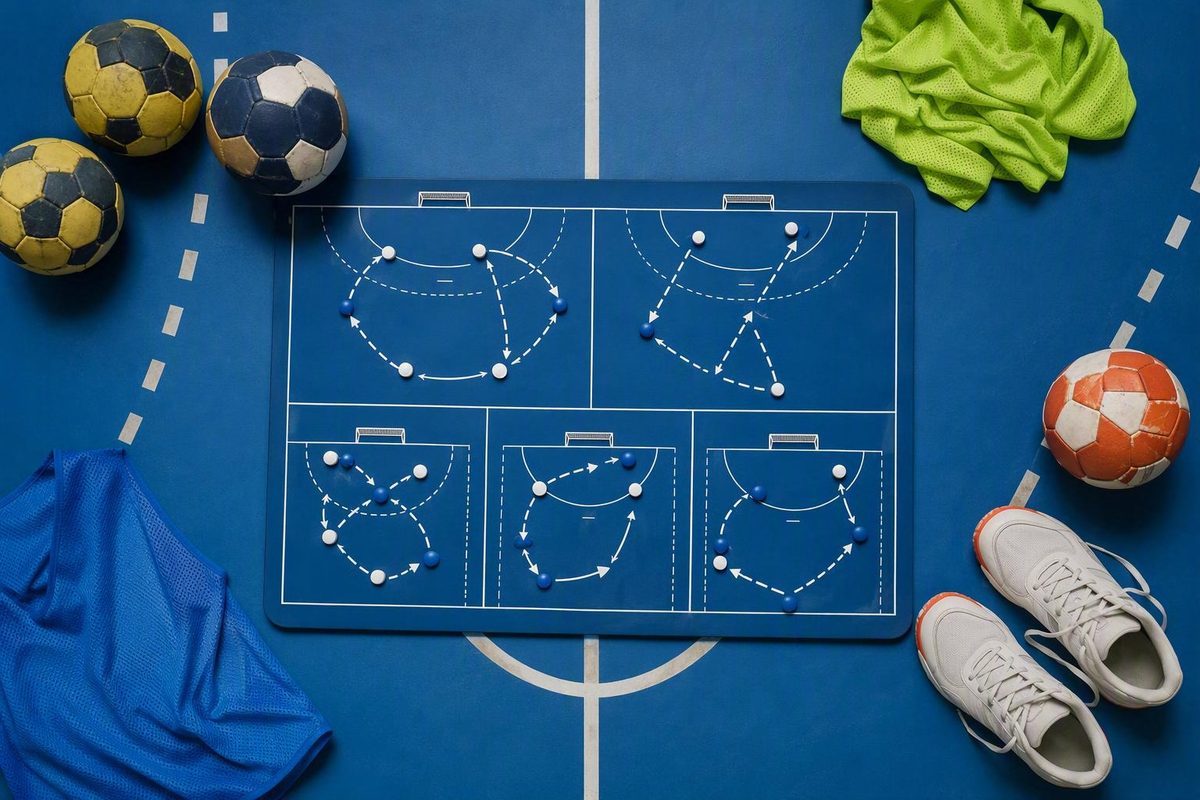
Every handball coaching manual assumes sixteen players and a full hall. Every actual club session starts with the coach counting heads and improvising. These five drills scale honestly from six players up, in the order a session should run them — with the coaching points that make them work.
1. The three-metre gauntlet (6+ players, warm-up)
Pairs, three metres apart, one ball: fifty passes as fast as clean technique allows — wrist snap, elbow up, ball arriving at chest height. Then stretch to five metres for shoulder passes. The coaching point that matters: receive moving toward the ball, never waiting flat-footed. Two minutes per distance, no lines, everyone touching a ball constantly — which is the design principle every later drill inherits.
2. Star passing (6–10 players)
Five stations in a star; ball follows the pattern, players follow their pass. With eight-plus players, add a second ball on the opposite point — the moment two balls run, heads must come up, and the drill starts teaching scanning rather than catching. Coaching point: the pass must land ahead of the moving receiver. When it gets comfortable, reverse direction without warning.
3. Two-ball pressure pairs (6+ players)
Pairs, two balls: one player bounce-passes while the other direct-passes, simultaneously, continuously. It looks like a circus trick and is actually a catching drill — soft hands, early eyes, rhythm under cognitive load. Sixty seconds on, thirty rest, swap roles. Players hate it for exactly one week.
4. The overload square (8–12 players)
A 10x10 metre square, attackers versus half as many defenders — 4v2 or 6v3 — keep-away with handball rules: three steps, three seconds. Defenders who win the ball swap out. The overload guarantees an open teammate exists; the drill teaches finding them before the pivot foot forces a bad decision. This is where passing becomes handball rather than catch.
5. Flow to goal (8+ players, needs a keeper)
Two lines at nine metres, one wing: pass-and-move pattern ending in a jump shot, immediately restarting from the other side. No standing: every pass is followed by a run to the next slot. Coaching points: passes arrive before the receiver’s outside foot plants, and the last pass must let the shooter rise without breaking stride. Ten minutes of this at pace is conditioning, passing, and shooting in one drill — which, with twelve players and one hall, is precisely the economy a real session needs.
Run 1-2-3 as the first twenty minutes, 4 as the middle block, 5 to close. The whole progression needs six players, half a hall, and zero cones of shame.