
You Can Take Up to Three Steps After You Stop Dribbling
Under IHF indoor handball rules, you may take up to three steps after gathering your dribble. The three-second limit and no second dribble still apply.
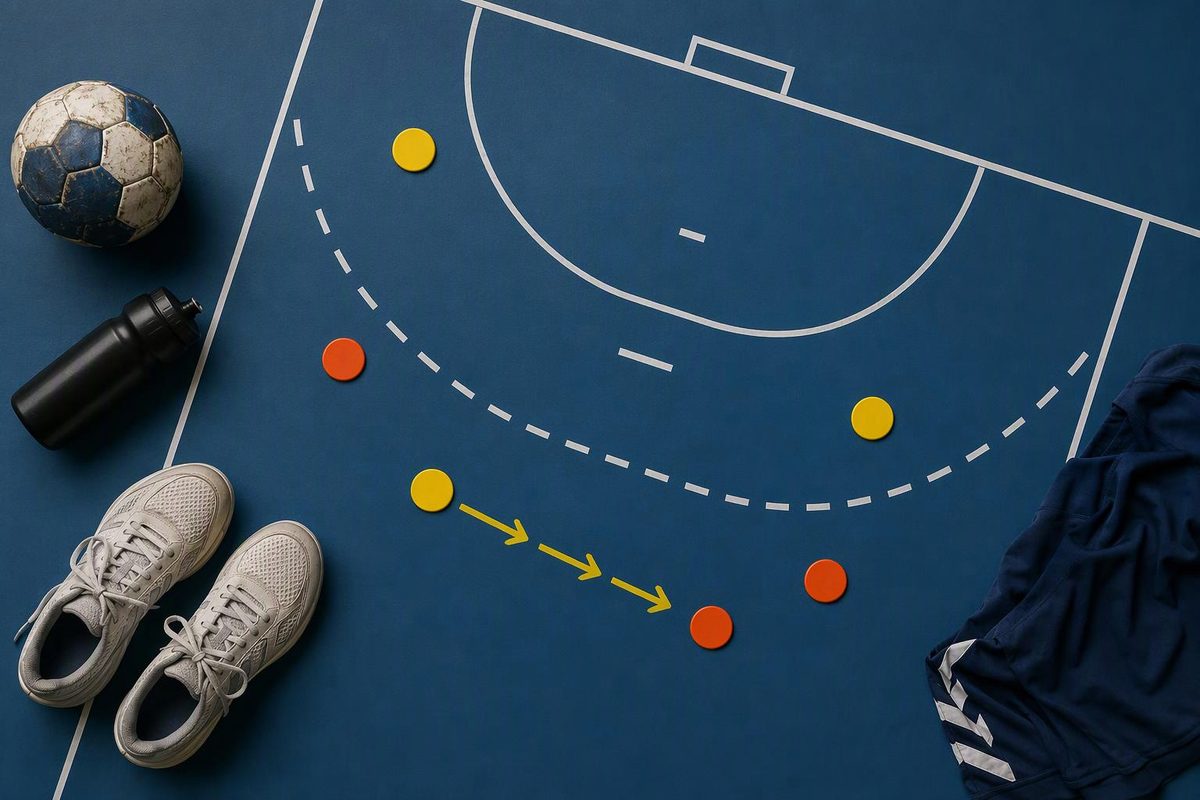
Under IHF indoor handball rules, you can take up to three steps after you stop dribbling. Once you catch or pick up the ball, you must pass or shoot within three seconds and before taking a fourth step—whichever limit you reach first.
Rule 7 allows a player to take no more than three steps after catching the ball following a bounce. Once the dribble has been gathered in one or both hands, the ball must be played within three seconds or after no more than three steps (IHF Rules of the Game for Indoor Handball, effective 1 March 2025, Rule 7).
What “stopping the dribble” means
The dribble ends when the player holds the ball in one or both hands, not when the ball makes its final contact with the floor.
From that gather, the player may:
- pass or shoot without taking a step;
- take one, two or three steps and then release the ball;
- hold the ball briefly, provided it is played within three seconds.
The player cannot gather the ball, take three steps and begin another dribble. Bouncing again after the gather is an illegal second dribble. Another dribble becomes possible after the ball has touched another player or the goal.
If a player exceeds the step or time limit, the opponents receive a free throw. For the other possession limits and common restarts, see our European handball rules guide.
Can you take three steps before and after dribbling?
Yes. A legal sequence can be:
- Receive the ball and take up to three steps.
- Start dribbling.
- Gather the dribble.
- Take up to three more steps.
- Pass or shoot.
That does not mean a player can take six continuous steps while holding the ball. Starting the dribble separates the two sets of steps.
When does the step count begin?
The detail that often causes disagreement is the first floor contact.
If a player gathers the ball while airborne, landing on one foot—or both feet simultaneously—is not counted as a step. The next qualifying foot movement starts the count. If the player catches while one foot is already on the floor, placing the other foot down counts as a step. If both feet are down, lifting one foot and placing it down again or elsewhere counts as one.
Avoid teaching every landing as an automatic “zero step.” It depends on whether the player had floor contact when possession was established. The IHF rulebook gives the full step definitions in Rule 7:3.
An eight-minute drill to make the rule visible
Players: 4–10 Space: One lane about 12 metres long and 4 metres wide per group Equipment: One ball per pair and four cones
Set out a start cone, a gather cone and two more cones in a straight lane. One player dribbles towards the gather cone, secures the ball there and calls “hold.” Their partner watches the feet and counts “one, two, three” as the steps occur. The ball carrier must pass back before a fourth step and within three seconds.
Run four rounds, asking for release after zero, one, two and three steps. Then add a shadow defender who applies positioning pressure without contact.
Checkpoint: Watch the feet from the instant the ball is secured. Correct the count, a late release or any attempt to restart the dribble—not the player’s running style. Once players are consistent, let them choose whether to release after zero to three steps so the movement becomes a decision rather than a memorised pattern.