
How to Play Handball: Rules, Decisions and a First Game
Learn indoor handball’s basic rules, what to do with and without the ball, and a 25-minute beginner practice for six adults in half a hall.
You play indoor handball by passing, dribbling and throwing the ball into the opposition’s goal, while defending your own. Each team normally has six court players and a goalkeeper. When you receive the ball, look for a shot, a pass to an open teammate or space to advance legally.
This guide covers indoor team handball, also called European handball—not wall handball or the beach version.
The rules you need for your first game
A regulation court is 40 × 20 metres, with a 3 × 2 metre goal at each end. Matches for players aged 16 and above normally have two 30-minute halves. A goal counts when the whole ball crosses the goal line legally; the team with more goals wins. These basics follow the IHF indoor rules effective 1 July 2025, Rules 1, 2, 4 and 9.
Remember these limits for court players:
- Three seconds: do not hold the ball longer than three seconds.
- Three steps: take no more than three steps while holding it.
- Dribble, then decide: you can bounce the ball repeatedly with one hand. Once you gather it, the three-step and three-second limits apply again. You cannot simply start another dribble; normally you must pass or shoot.
- Feet and lower legs: you cannot touch the ball with the foot or leg below the knee, except when an opponent throws it at you.
You do not have to use all three steps. Catching and passing immediately is legal. The step-counting details and dribbling exceptions are in IHF Rule 7. The holding and movement limits do not apply to a goalkeeper with the ball inside their own goal area.
The six-metre goal area is reserved for the goalkeeper, including its boundary line. For a jump shot, take off outside the area and release before landing inside. Entering after releasing is not penalised provided it does not disadvantage opponents. Beginners can start with standing shots from outside the line. See IHF Rules 5 and 6.
Handball permits controlled body contact, but not holding, pushing, or running or jumping into an opponent. Many infringements lead to a free throw; illegally destroying a clear scoring chance leads to a seven-metre penalty throw. After a goal, the conceding team restarts with a throw-off at centre. For a sideline throw-in, keep one foot on the sideline until release. These are covered by IHF Rules 8 and 10–14.
For fuller restart and match guidance, use the European handball rules guide.
What to do during play
With the ball: look towards goal before committing to a dribble. Shoot if you have a clear, controlled opportunity. Pass if a teammate has a better opening. Use the dribble to travel through available space, not as an automatic first action.
Without the ball: spread out and move where the passer can see you. Show your hands, receive facing useful space and move again after passing. Avoid standing directly behind a defender, where the passing route is blocked.
In defence: stay between your opponent and the goal. Move your feet to follow them and watch both the ball and nearby attackers. For a first practice, teach interceptions and positioning without contact.
When possession changes: react immediately. If your team loses the ball, recover towards your goal; if it wins the ball, offer a forward passing option.
Teach it in 25 minutes: six adult beginners, half a hall
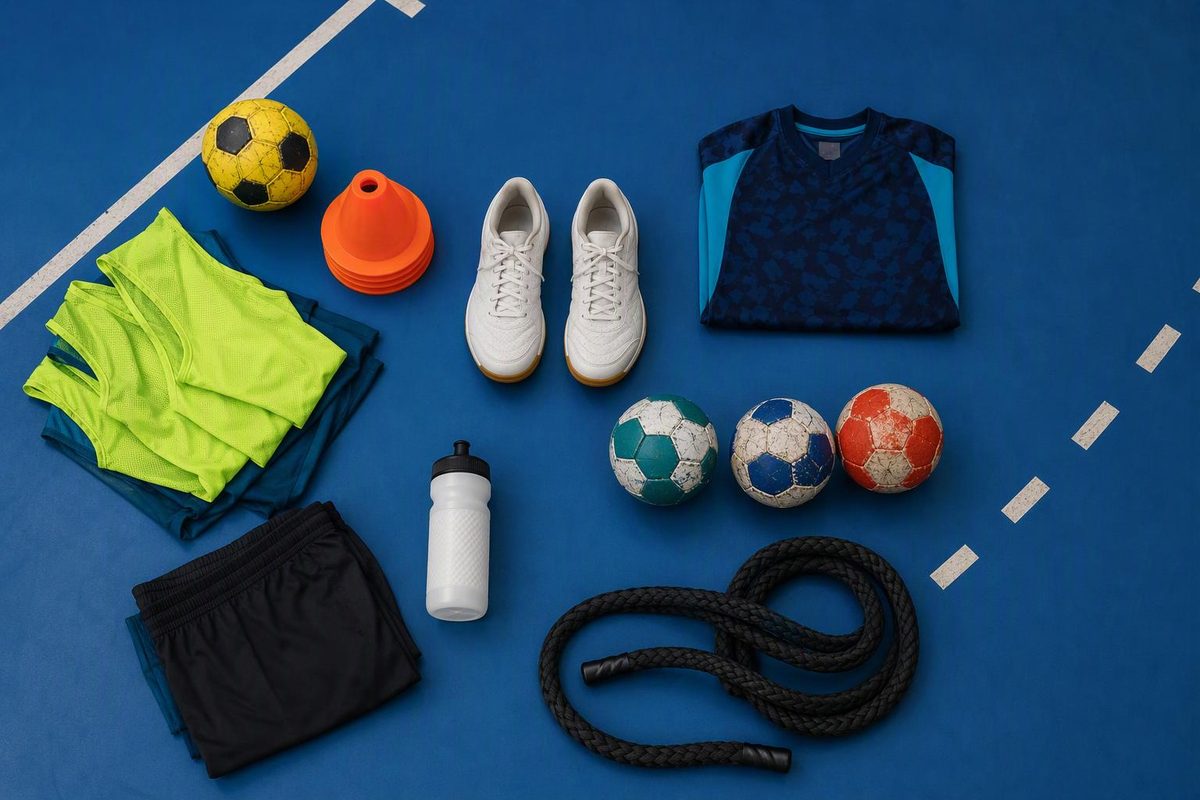
This is a suggested coaching block, not a regulation match. Use six players, three balls, bibs, cones and one securely fixed goal. No goalkeeper is required. Choose balls players can grip comfortably and keep the shooting space clear. Use the half-court boundaries, or mark them with cones, leaving clear space outside them. Identify the six-metre goal-area line and the dashed nine-metre line before starting.
1. Warm up and pass — 10 minutes
Spend five minutes on easy movement, changes of direction and gentle partner throws. Then pass in pairs for five minutes, starting roughly three metres apart. Progress from stationary catches to catching, taking one or two steps and passing.
Watch: can the receiver control the ball without chasing it? Reduce distance or speed if catches repeatedly break down.
2. Catch and shoot — 5 minutes
Use two groups of three, alternating through one shooting lane: passer, shooter and collector. The collector stays clear until the shot finishes. Receive outside the six-metre line and make a controlled standing shot. Rotate roles within each group after its attempt.
Watch: does the ball leave the hand before the shooter touches the goal-area line? Prioritise legal footwork and accuracy over power. Build the technique later with the shooting-form checklist.
3. Play three against three — 10 minutes
Use one ball and play towards the same unguarded goal, with no contact and standing shots only. Defenders may intercept passes but cannot take the ball from someone’s hands. Apply the three-step and three-second limits.
After an interception, the new attacking team must pass to a teammate beyond the nine-metre line before attacking. Stop play after every shot, collect the ball once the shooting space is clear, and give the other team possession beyond that line. Use the same reset after a ball goes out or an attacking rule violation. These are practice reset rules, not official restarts.
Checkpoint: look for players spreading out, moving after passing and choosing a shot without extra steps. If beginners freeze under pressure, briefly remove one defender, then restore three against three once passes flow.