
The Handball Rules That Decide Most Calls, From a Club Coach
Seven a side, two 30-minute halves, three steps, three seconds, one dribble, and only the keeper in the 6 m area: the handball rules that decide most calls.
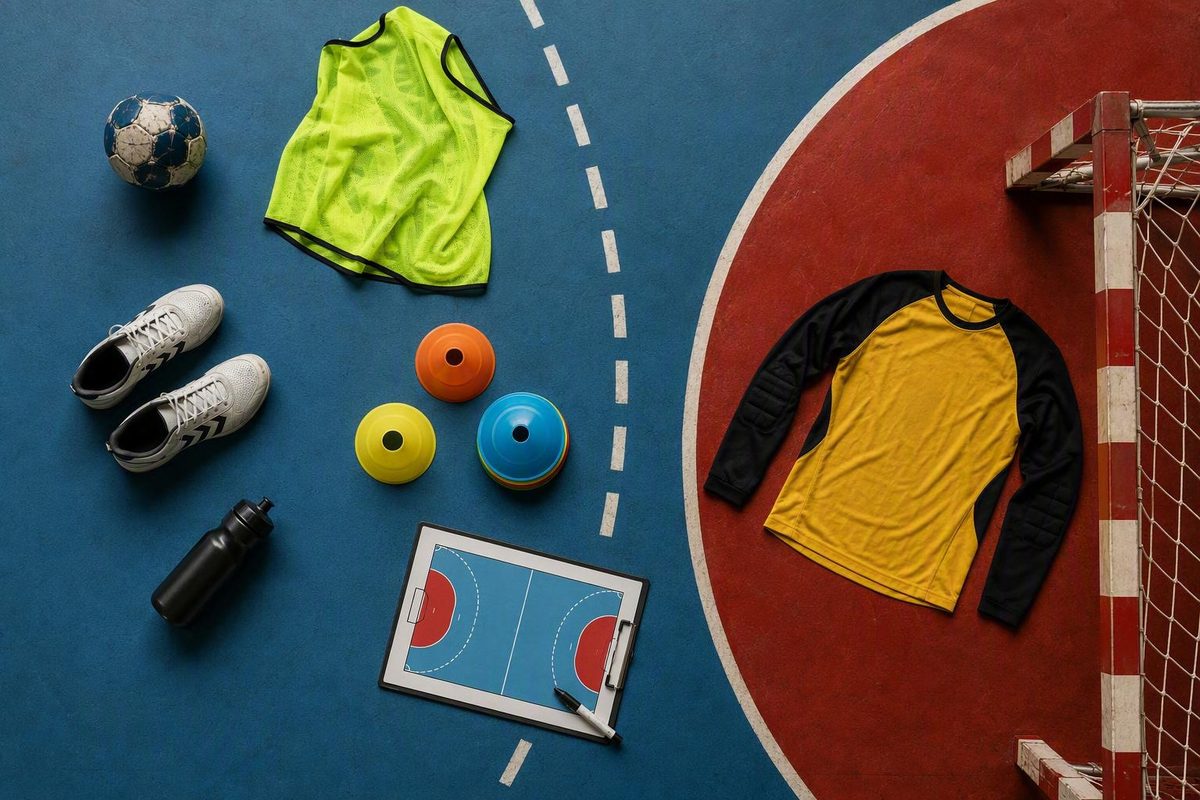
“European handball” is indoor team handball: seven players a side, six court players and a goalkeeper, on a 40 m by 20 m court, scoring by throwing the ball into a goal 3 m wide and 2 m high. Senior matches run two 30-minute halves. The rules that decide most calls are short. A player holding the ball has three steps and three seconds to pass, shoot or start a dribble, and gets one dribble per possession. Only the goalkeeper may stand inside the 6 m goal area. Defenders may block with the body but may not hold, push or strike. More goals wins, and a draw stands unless the competition requires a winner.2
The dated reference for everything below is the IHF Rules of the Game for Indoor Handball of 1 March 2025, which sets the court, goal, playing-time, overtime and time-out framework.1 Beach handball, wheelchair handball, mini-handball and school formats use adapted rules, and leagues add their own competition regulations, so check which edition governs your match.
The Rules at a Glance
| Rule | Standard |
|---|---|
| Players on court | Seven per team: six court players and one goalkeeper |
| Senior match length | Two 30-minute halves (ages 16 and above) |
| Court | 40 m long, 20 m wide |
| Goal size | 3 m wide, 2 m high |
| Holding the ball | No more than three seconds |
| Moving with the ball | No more than three steps |
| A goal | Whole ball across the goal line, no preceding violation |
Teams create shots through passing, dribbling, off-ball movement, screens and controlled contact. After a goal, the team that conceded restarts with a throw-off.2
The IHF framework is wider than the rules text: it includes comments, referee hand signals, clarifications, guidelines and interpretations, and the Substitution Area Regulations, with separate regulations for protective equipment, electronic team time-outs and video replay.3
Three Steps, Three Seconds, One Dribble
This is the rule new players break most, so it comes first.
Once a player controls the ball, the clock and the step count start. Three seconds to pass, shoot or begin dribbling; three steps while holding the ball. Exceeding either is a violation and the other team gets a free throw.4
A dribble extends the run but does not reset the sequence for free. When the player ends the dribble and controls the ball again, both limits apply afresh: three more steps and three more seconds to pass or shoot. What the player cannot do is bounce the ball again. A second dribble after controlling the ball is a double dribble.4
So the full legal sequence is: catch, up to three steps, dribble, catch, up to three steps within three seconds, pass or shoot. Anything added past that is a free throw.
Set the ball carrier’s steps, dribble and holding time; the verdict updates beside the controls.
Is This Possession Legal?
Legal: pass or shoot now
- 3 steps after the catch (limit 3).
- One dribble, then 3 steps (limit 3).
- Holding time not entered; the three-second limit still applies.
| Limit | Value |
|---|---|
| Steps while holding the ball | 3 |
| Seconds holding the ball | 3 |
| Dribbles before you must pass or shoot | 1 |
| Sanction for exceeding any of these | Free throw to the other team |
Source: IHF Rules of the Game, Indoor Handball, 1 March 2025. Checks ball-carrier limits only; contact, goal-area and passive-play rules are separate.
Court players may play the ball with the hands, arms, head, torso, thighs and knees, anything from the knee upward. Below the knee is not allowed for a court player; only the goalkeeper inside the goal area has that privilege.4
In training I coach the decision, not the count. Scan before receiving, use the available steps to attack space, and release the ball before either limit becomes a problem. Players who count steps in their head are already late.
Court Markings, Players and Match Length
The court is 40 m by 20 m with a safety zone of at least 1 m outside the sidelines and 2 m behind the goal lines. Goals measure 3 m wide by 2 m high on the inside.1
| Line | Distance | Purpose |
|---|---|---|
| Goal-area line | 6 m | Goalkeeper’s area; court players stay out |
| Free-throw line | 9 m, broken | Attackers set up here for free throws near goal |
| Penalty line | 7 m | Where 7 m throws are taken |
| Goalkeeper restraining line | 4 m | Keeper’s limit during a 7 m throw |
The 6 m line is not a plain semicircle: it is a 3 m straight segment in front of the goal joined to two quarter-circles, and the broken 9 m line follows the same shape 3 m further out.1 That matters for wing players, whose shooting angle depends on where the arc meets the goal line.
Each team fields up to seven players: six court players and a goalkeeper. Wing, back and pivot are tactical positions, not categories in the rulebook.
Playing time by age under the base rules:1
| Age group | Playing time |
|---|---|
| 16 and above | Two 30-minute halves |
| 12–16 | Two 25-minute halves |
| 8–12 | Two 20-minute halves |
Competitions regulate the half-time break, squad size and youth arrangements themselves, so a shortened festival game or school format does not mean the age-group standard has changed.
Goal Area, Goalkeepers, Scoring and Substitutions
Only the goalkeeper may occupy the 6 m goal area. A court player may not stand in it, carry the ball through it, or step in to gain an advantage.
Attackers may be in the air above the area. A wing player can take off from outside the 6 m line, release the ball before touching the floor, and then land inside the area. The ball has to leave the hand before the player lands; that is the whole test.5
Inside the goal area the goalkeeper may use feet and lower legs to defend. Court players never may.
A goal stands when the entire ball crosses the full width of the goal line with no violation beforehand. A ball on the line is not a goal. Play restarts with a throw-off by the team that conceded.5
Substitutions are rolling and can happen during live play, but the outgoing player must be off before the replacement enters, and both go through the team’s own substitution area. A court player may also replace the goalkeeper, which gives the team an extra court player in attack and an empty goal.2 Entering early is a substitution infringement, not a timing quibble; the punishment procedure is in the rules edition the competition has adopted.
Legal Contact, Fouls and Restarts
Handball allows controlled contact. A defender may take a frontal position and use the torso, bent arms or open hands to block an attacker’s route. Occupying space and stopping progress is legal; grabbing, striking or endangering is not.2
Legal, as a rule: frontal position, absorbing contact with the torso, guiding or blocking with bent arms. Illegal: holding, pushing, pulling clothing, striking, grabbing an arm, or any dangerous contact.
An ordinary infringement gives a free throw. Defenders stay at least 3 m from the thrower. Near the defending goal the attack sets up outside the broken 9 m line while the defence stands closer to the 6 m area.6
If an illegal action destroys a clear scoring chance, the sanction is a 7 m throw. Pulling back an attacker who is through on the goalkeeper is the standard example. A hard foul at 12 m does not produce a 7 m throw by itself; the question is whether a clear chance was illegally prevented.
| Restart | When |
|---|---|
| Throw-off | Start of each half; after every goal |
| Free throw | Most ordinary infringements |
| 7 m throw | A clear scoring chance illegally prevented |
| Throw-in | Ball fully crosses a sideline, and other boundary cases |
| Goalkeeper throw | Specified goal-area and outer-goal-line situations |
The 7 m line is an in-game penalty mark first and a tie-break location second. The award and execution procedures run longer than this table; the competition’s rulebook has them.
Passive Play and the Punishment Ladder
A team may not hold the ball indefinitely without attacking. Passive play is possession with no recognizable attempt to create a shot or move toward goal.
When the referees judge an attack is turning passive they raise the forewarning signal. After that the attacking team has at most four passes to get a shot away before the referees award a free throw to the defence.7
This is not a rule against patience. An attack can reshape, move defenders and set up a planned action. It is a rule against possession with no intent. Once the arm goes up, the next passes must lead to an attempt.
Personal punishments escalate:
- Warning: a yellow card, for conduct handled progressively.
- Two-minute suspension: the player leaves the court and the team plays a player short for two minutes.
- Disqualification: the player takes no further part.
A player’s third two-minute suspension is a disqualification. After a disqualification the team stays reduced for two minutes, then may bring on another player. Dangerous conduct can go straight to a suspension or disqualification without passing the earlier steps.8
A blue card shown after the red means the referees will file a written report and the competition authority will consider further action. It does not by itself fix a fine or a ban.8
Draws, Overtime, Time-Outs and What Your Competition Decides
A match may end level when the competition allows a draw. Overtime is only played when the format demands a winner.
Under the base procedure, overtime follows a five-minute break and consists of two five-minute halves with a one-minute interval. If still level, a second identical overtime is played.1
If there is still no winner, the competition regulations set the next step. Where alternating 7 m throws are used, each team names five eligible throwers and the teams alternate; any continuation beyond those five follows the prescribed procedure.1
The base time-out allowance is one one-minute team time-out per team in each half of regular time, with none in overtime. Authorised competitions may instead permit three one-minute team time-outs per match, with additional limits.1 That is why the time-out pattern differs between leagues you watch.
Before a tournament, confirm five things with the organiser: the team time-out allowance, the match-squad size, whether a central throw-off area or another authorised arrangement applies, whether a draw stands or triggers overtime and which tie-break follows, and whether video replay is available.
The memory aid I give new parents on the bench: seven players, two 30-minute senior halves, three steps, three seconds, only the goalkeeper in the 6 m area. That covers most of what they will see. For procedure, use the IHF edition adopted by the competition together with its own regulations.
Are European Handball and Team Handball the Same Sport?
Yes. European handball, team handball and indoor handball all name the same seven-a-side court sport. “European” separates it from other games called handball and from the handball offence in football; there is no separate European rules code.
Can a Handball Match End in a Draw?
Yes, when the competition permits it. Overtime and a tie-break are used only when the format requires a winner, so a league match and a knockout tie can finish under different procedures.
How Long Are Youth Handball Matches?
Under the base IHF rules, ages 12–16 play two 25-minute halves and ages 8–12 play two 20-minute halves.1 Local youth leagues, school competitions and mini-handball events often shorten these.