
Handball vs Weights for Bone Health: What the Research Actually Shows
No direct, dose-matched evidence establishes a winner; biomarker signals do not prove denser or mechanically stronger bones or fewer fractures.
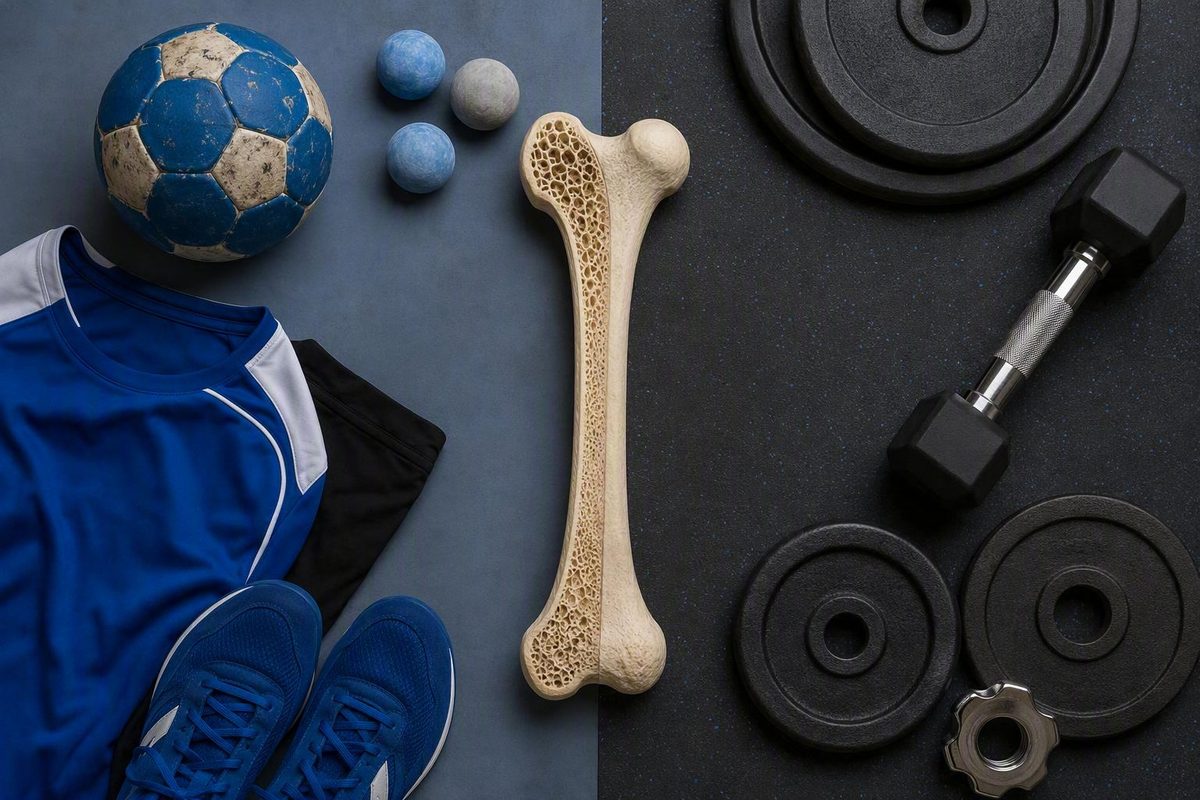
Current evidence does not establish that handball builds stronger bones than a matched weightlifting program. A 2026 meta-analysis reported a larger response to recreational football and handball in selected bone-formation biomarkers, but it did not directly measure bone strength, bone mineral density or fractures—and the public reporting did not separate handball from football.
The useful comparison is therefore about loading, not declaring a winner. Handball supplies rapid impacts and multidirectional movement; lifting supplies targeted resistance that can be adjusted and progressed.
Related: Handball Practice Plan for Mixed Skill Levels.
The short answer: handball is promising, but superiority is not proven
The claim that handball “beats” lifting goes beyond the available research. The headline result concerned biological markers associated with active bone formation. It did not show that handball produced denser bones, mechanically stronger bones or fewer fractures than resistance training.
Football and handball were also reported together.
Resistance training has separate support as a way to preserve bone and potentially improve it. Muscles and tendons place mechanical stress on the skeleton, while exercise selection can deliberately load areas such as the hips, spine and upper extremities. Reviews of handball research also describe resistance training as beneficial for bone development, particularly at the hip and spine.
The defensible verdict is:
- Handball offers an interesting bone-formation biomarker signal, alongside rapid impacts and changes of direction.
- Lifting remains a credible bone-health activity, with controllable loading and clear opportunities for progression.
- No direct, dose-matched evidence establishes an overall winner.
What the 2026 meta-analysis found—and what it did not
The analysis covered 24 clinical studies involving 1,238 healthy adults. According to the Semmelweis University report, recreational football and handball were associated with relative increases of approximately 45–46% in selected bone-formation biomarkers. Walking, step aerobics and resistance training showed no statistically significant long-term change in those particular markers.
That is a narrower finding than many headlines suggest. The public summaries do not identify the specific biomarkers behind the percentage, explain precisely what reference value the relative increase used, define “long-term,” or report confidence intervals and heterogeneity. Without those details, the figure should be treated as a reported summary result rather than a complete estimate of the effect.
The result also does not establish comparative changes in bone mineral density, mechanical strength or fracture incidence. Football and handball were presented together in the supplied reporting, so it remains unclear whether they were pooled analytically in every relevant comparison or whether handball alone produced the reported response.
The researchers proposed high intensity, explosive movement and rapid changes of direction as an explanation for the larger marker response. Medical Xpress’s coverage presented intensity as the proposed driver. That remains an interpretation rather than proof that exercise type, loading pattern, progression and total work are unimportant.
The publication trail can make the result look more extensively confirmed than it is. The Semmelweis article, the Medical Xpress report and the EurekAlert release all describe the same analysis. The EurekAlert release identifies the review as a Sports Medicine – Open publication; it is not a third independent experiment reproducing the finding.
The available summaries also provide too little detail about the resistance-training programs for a fair programming comparison. Exercises, loads, repetition ranges, weekly frequency, progression, intervention length and participant characteristics can all alter the skeletal stimulus. “Resistance training” can describe anything from an unchanging light circuit to a deliberately progressed strength program.
A non-significant change in the selected biomarkers therefore does not mean lifting has no bone-health value. It means those markers did not show a statistically significant long-term change across the resistance-training evidence included in this analysis.
A biomarker increase is not the same as a stronger bone
Bone-formation biomarkers are biological signals associated with active bone formation. They can respond sooner than slowly changing skeletal measurements, which makes them potentially useful for detecting an early metabolic response to exercise.
They are still surrogate outcomes. A relative increase in a biomarker does not imply an equivalent increase in bone density, mechanical strength or protection against fractures.
Four distinct outcomes matter here:
- Bone-formation biomarkers: Biological signals related to active bone formation.
Bone mineral density is relevant to fracture risk, but it does not capture every component of skeletal strength. Bone structure and microarchitecture also contribute, while fracture risk extends beyond the bone itself. The narrative review of bone health in handball players likewise treats bone mineral density and content as useful predictors rather than complete measures of bone strength or fracture resistance.
To support a claim that one activity creates stronger bones or prevents more fractures, research would need to compare well-matched programs over sufficient time and measure longer-term skeletal or clinical outcomes. Biomarkers can identify a promising response, but they cannot settle the handball-versus-lifting question alone.
How handball and lifting load the skeleton differently
Bone responds to the forces placed upon it, but force is not a single uniform stimulus. How large the force is, how quickly it arrives, how often it occurs and from which direction can all affect the loading pattern. The skeletal site receiving that load matters as well.
| Feature | Handball | Progressive lifting |
|---|---|---|
| Loading pattern | Jumps, landings, sprints, throws and cuts | External resistance plus muscular and tendon forces |
| Speed and direction | Often rapid, multidirectional and asymmetrical | Usually controlled and repeatable; speed varies by exercise |
| Likely skeletal regions | Legs, hips, spine, throwing shoulder and arm | Hips, spine, wrists and limbs, depending on exercise |
| Controllability | Variable because play is reactive | Load, range, repetitions and exercise choice can be adjusted |
| Direct evidence | Favorable observations and limited intervention evidence | Separate support for bone preservation or improvement |
| Main limitation | Movement exposure varies considerably between sessions | Poor exercise selection or limited progression can reduce the intended stimulus |
These loading patterns and their site-specific effects are consistent with the American Academy of Orthopaedic Surgeons’ exercise and bone-health guidance.
Handball combines several potentially useful forms of loading. Jumping and landing generate rapid lower-limb forces. Sprinting and cutting alter the direction and rate of those forces. Throwing repeatedly loads the dominant arm and shoulder differently from the non-throwing side. Contact is a feature of the sport and a source of risk to manage; it should not be treated as a bone-building exposure to maximize.
Lifting works differently. Muscles and tendons transmit force to bones while the athlete moves or stabilizes an external load. Exercise selection can emphasize the hips and spine through lower-body movements and loaded carries, or place more stress on the upper extremities through pressing, pulling and carrying.
Adaptation is site-specific. Court movement and jumping primarily challenge the legs and hips; they do not automatically supply an equivalent stimulus to the wrist or every region of the spine. Throwing may be associated with distinctive dominant-arm measures, while lifting can deliberately load areas that sport participation underuses.
Neither pattern is universally superior. A demanding handball session differs from low-intensity technical practice, just as progressively loaded strength exercises differ from an unchanging light circuit. The likely effect depends on the skeletal site, loading intensity, progression, age, health, training history, program design and consistency.
What handball-specific bone research can support
A narrative review associates handball participation with favorable bone mineral density and bone mineral content at several skeletal sites. It identifies jumping, landing, sprinting, throwing and torsional loading as plausible contributors while acknowledging that relatively few studies have specifically examined bone health in handball players.
One intervention involving older women reported a 1.5% increase in lumbar-spine bone mineral density after 16 weeks of handball training. The reported 0.9% increase at the femoral neck was not statistically significant. Cross-sectional studies found proximal-femur and lumbar-spine bone mineral density to be 8–10% higher in older female handball players than in untrained controls, while adolescent female players also had higher lumbar-spine and femoral-neck measurements than inactive adolescents, as summarized in the handball bone-health review.
Some studies also found higher bone measures in dominant arms or forearms than on the non-dominant side. Those patterns are consistent with site-specific exposure to repeated throwing loads, but they remain associative and do not by themselves prove that handball caused the differences.
Study design matters. A 16-week intervention can assess change over time following a defined activity. A cross-sectional study instead compares established players with another group at one point. It cannot determine how much of a difference was caused by handball or exclude athlete selection, nutrition, previous training and other physical activity.
The literature is also heterogeneous. Participants differ in age, sex and playing history, while studies examine different skeletal sites and use different comparison groups. Most importantly, the available handball studies do not compare players with participants following matched progressive resistance-training programs.
The evidence therefore supports handball as a meaningful source of site-specific skeletal loading. It does not establish how that stimulus compares with an equally well-designed lifting program.
The practical choice: use the right loading mix for the person
The decision should reflect the person, the skeletal sites of interest, what they can perform consistently and what they can tolerate safely.
| If the priority is… | Practical choice | Why |
|---|---|---|
| Controllable, targeted loading | Progressive lifting | Exercises, ranges and loads can be adjusted for specific regions |
| Impact plus team-sport participation | Recreational handball | Adds jumping, cutting, sprinting and throwing when safely tolerated |
| Broader skeletal loading | Consider both | Combines targeted resistance with rapid, multidirectional impact |
For a suitable adult, combining progressive resistance training with appropriately introduced impact activity is a reasonable, evidence-informed approach—not a proven superior prescription. Lifting can target the hips, spine and upper body deliberately, while handball can add rapid lower-limb impacts, changes of direction and distinctive throwing-arm loads.
Coaches should not interpret the biomarker result as a reason to replace strength work with additional handball. Nor does it justify prescribing a precise bone-building dose of court training.
Practical progression should include:
- Increasing lifting loads and exercise demands gradually.
- Using sound technique and an appropriate range of motion.
- Introducing jumping, cutting and high-speed work progressively.
- Warming players up before demanding activity.
- Introducing contact progressively rather than treating it as extra conditioning.
- Allowing sufficient recovery and considering total court, gym and match load.
People with osteoporosis, elevated fracture or fall risk, joint problems, or cardiovascular, musculoskeletal or metabolic conditions may need clinical guidance and exercise modification before beginning high-intensity handball or heavy lifting. Depending on the person, jumping, contact, twisting or heavy resistance may need to be limited or adapted; the Semmelweis report also advises clinical consultation before high-intensity exercise for people with relevant medical conditions.
For many players, handball versus weights is a false choice: the research gives football and handball an interesting biomarker result, not a decisive victory over lifting. Both activities can support bone health through different loading patterns, and suitable people may benefit from combining progressive strength work with safely progressed impact activity. What remains unanswered is whether a dose-matched handball-versus-lifting trial would find meaningful differences in bone density, mechanical strength or fractures.