
One Session, Three Levels: A Practical Plan for the Whole Squad
Use a 70-minute progression from ball handling and passing to shooting, defended decisions and a small-sided game, with three difficulty lanes.
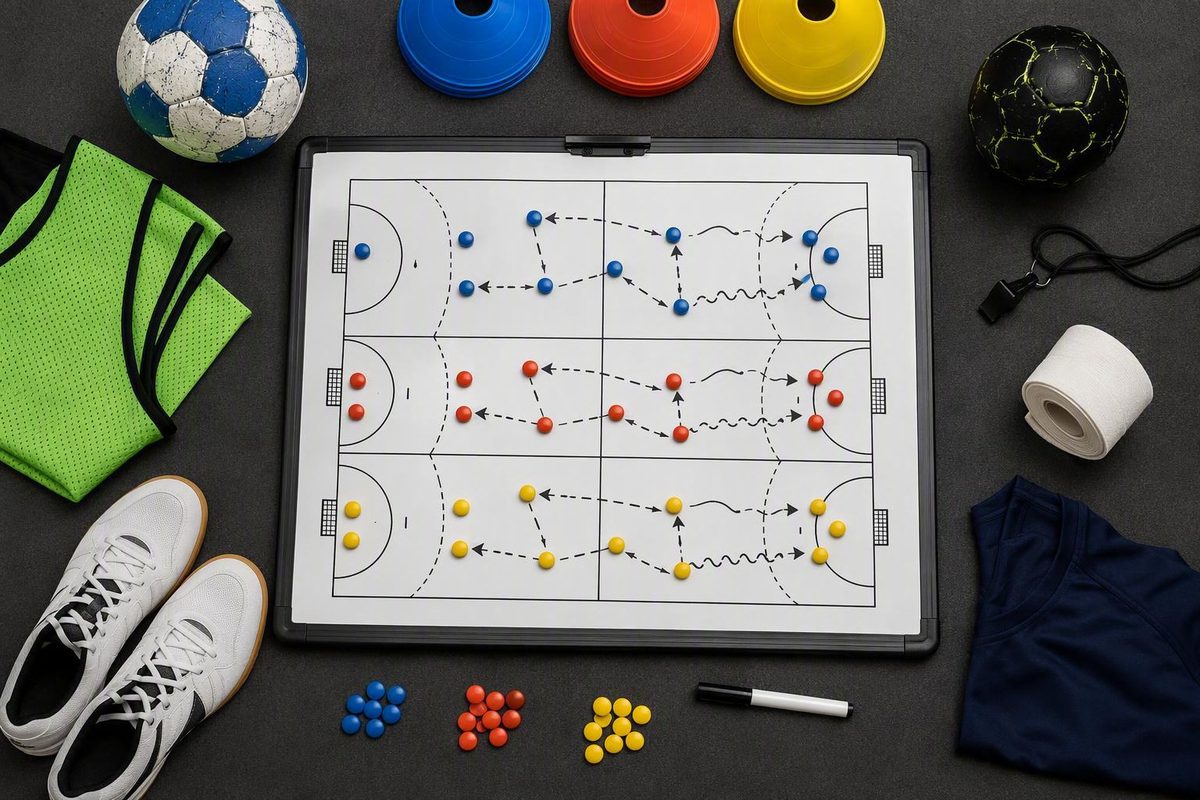
Run one shared objective in three versions—supported, standard, and challenge—instead of assigning a different drill to each ability group. This 70-minute handball practice progresses from ball handling and passing to shooting, defended decisions, and a small-sided game. Adjust the ball, target, space, time, or defender pressure so players can work on the same theme at an appropriate level without being permanently labeled beginner, intermediate, or advanced.
The 70-minute mixed-level practice at a glance
The default objective is to improve passing and catching while moving, spacing after release, shooting decisions, and responses to defensive pressure.
This schedule is an editorial synthesis of adaptable, game-based teaching principles—not an IHF-prescribed sequence or a scientifically validated optimum. The IHF Handball at School teacher guide supports learning by doing, small-sided play, staged instruction, and adapting rules or equipment for a clear teaching purpose.
| Time | Activity | Main objective | Difficulty lever |
|---|---|---|---|
| 0–8 min | Dynamic ball warm-up | Handling and movement | Ball, speed, reaction cue |
| 8–20 min | Passing and catching | Control while moving | Distance, space, opposition |
| 20–35 min | Movement and shooting | Receiving, spacing, finishing | Target, range, defender |
| 35–47 min | Defended decisions | Scan and choose under pressure | Defender, space, time |
| 47–65 min | Small-sided game | Apply the session theme | Touches, scoring, support |
| 65–70 min | Cooldown and review | Lower intensity and observe | Questions and feedback |
Plan for approximately 8–14 players, half or full court, several appropriately sized balls, cones, bibs, and one goal if available. A specialist goalkeeper is not required: use a rotating goalkeeper, cone targets, a suitable wall target, a marked scoring zone, or an end-zone receiver.
Use three adjacent difficulty lanes throughout:
- Supported: More time, shorter distances, a soft or smaller ball, larger targets, predictable movement, and little or no defensive pressure.
- Standard: The core activity performed while moving, with realistic but manageable decisions.
- Challenge: Less space or time, weaker-hand actions, smaller targets, reaction cues, or more active opposition.
Move players between lanes according to what they execute that day. Someone may need support when catching under pressure but be ready for the shooting challenge. The lane describes the task, not the person.
Before the session, complete an operational check: confirm ages, attendance, medical or accessibility considerations, goalkeeper availability, and local contact rules. Inspect the floor and equipment, secure goals and targets, and arrange lanes so moving groups do not cross.
Set up the group without labeling players
As practical editorial guidance, begin technical work in readiness-matched pairs or trios. This gives less-confident players a controllable starting task while allowing experienced players to work at an appropriate pace. During defended activities, rotate partners and avoid large physical or technical mismatches.
Build balanced mixed-ability teams for the final game, but do not expect team selection alone to distribute involvement. A balanced team can still funnel every possession through its strongest player, so use one or two constraints to change who receives, supports, assists, or finishes.
Change the grouping to suit the task:
- Readiness-matched pairs for early technical repetitions.
- Rotating partners for opposed decisions.
- Balanced mixed teams for game application.
- Frequent role changes so young players attack, defend, shoot, and face shots before specializing.
Where space permits, mark three adjacent working areas. Every lane then practices the same objective, and players can change difficulty without waiting for another drill explanation.
Use this constraint ladder:
- Ball or target: Change ball softness or size, passing distance, shooting range, or target size.
- Space: Widen or narrow the channel or receiving area.
- Time or allowances: Add preparation time, introduce a decision deadline, or alter permitted steps as a teaching constraint.
- Defender pressure: Progress from none to passive, half-active, and active.
Change one main lever at a time. If you simultaneously shrink the area, shorten the decision window, and activate the defender, it becomes difficult to identify which change disrupted execution.
Minutes 0–20: ball warm-up, passing, and catching
Minutes 0–8: continuous ball handling
Mark parallel lanes with adequate distance between moving players. Keep everyone active with ball wraps around the head, waist, and legs; controlled dribbling; changes of direction; and short partner exchanges.
- Supported: Work stationary, use a soft or smaller ball, catch with two hands, pass over a short distance, and allow extra preparation time.
- Standard: Handle and exchange the ball while walking or jogging.
- Challenge: Use the weaker hand, react to a color or direction call, change direction before passing, or pass through a tighter window.
Players should move at a pace that preserves control. If balls repeatedly enter another lane, increase the spacing or reduce the movement speed.
Minutes 8–20: pass, follow, and receive on the move
Use one ball per pair or trio where possible, with cones defining clear channels. Begin with stationary passes, progress to pass-and-follow movement, and then ask receivers to catch while moving into the next space. Switch the lead passer, direction, or starting side every two to three minutes.
Coach five concise points:
- Show the passer a clear target.
- Move toward the pass rather than waiting flat-footed.
- Release in front of a moving receiver.
- Look up before receiving.
- Move into new space immediately after passing.
Once players can repeatedly catch cleanly and deliver controllable passes without stopping the receiver, add one interceptor. Begin with the interceptor occupying a passing lane without trying to win every ball, then progress to half-active pressure. One educational lesson-plan example follows a similar sequence from stationary throwing and catching to movement and defended reception, while using varied balls, larger targets, or extra time as adaptations.
If players struggle, shorten the pass, stop the receiver, use a softer ball, widen the channel, or allow more possession time. If the task is easy, narrow the channel, add a second ball, require the weaker hand, or introduce a late decision cue.
Use observable checks rather than a universal completion percentage:
- Clean catches without trapping the ball against the body.
- Passes that allow the receiver to continue moving.
- A scan before reception.
- Movement into useful space after release.
Minutes 20–35: movement and shooting stations
Run two stations for approximately seven minutes each, with one minute to change over. One group works on receive-and-shoot actions while the other practices spacing and support movement.
Station 1: receive and shoot
Place a passer to the side or behind the shooting line. The attacker passes, moves to receive, and finishes at a goal, cone target, suitable wall target, or marked scoring zone. Keep queues short with two starting points or a second target. Rotate the goalkeeper role when appropriate for the group.
- Supported: Shorter range, larger target, no defender, and permission to set the feet before release.
- Standard: Receive while moving and shoot without breaking stride.
- Challenge: Add a feint, weaker-side finish, smaller target, late directional cue, or passive defender.
Coach players to arrive balanced, receive where the next action remains possible, and choose placement rather than uncontrolled power. The passer should release early enough for the receiver to continue toward the target.
Station 2: spacing and support movement
Mark three or four receiving areas with cones. Players pass and immediately move to an open area rather than following the ball automatically.
- Supported: The coach names or numbers the destination cone.
- Standard: The player identifies and moves to an open cone after passing.
- Challenge: Add an interceptor, or require the player to reject the first available area and create a second option.
Keep passing lanes visible and address bunching early. If two players enter the same area, pause briefly, identify the unused space, and restart.
Larger targets, alternative balls, extra time, and floor zones are teaching adaptations rather than the complete official rules. If there is no goal or goalkeeper, use targets that preserve repetitions instead of creating a long shooting queue.
Minutes 35–47: defended decisions with adjustable pressure
Set up one or more narrow channels leading toward a goal or cone target. Play two attackers against one defender, or use a receive-and-finish pattern in which the ball carrier chooses whether to pass, drive, or shoot. Waiting players act as feeders, support runners, receivers, or rotating defenders.
Use one pressure scale across every channel:
- Unopposed: Learn the route and available options.
- Passive: The defender occupies one obvious lane.
- Half-active: The defender applies positional pressure without contesting every action at full speed.
- Active: The defender attempts to stop the attack within the session’s contact rules.
Supported players begin against a passive defender who removes one obvious option. Standard players face half-active pressure. Challenge players face an active defender, a tighter channel, or a shorter decision window—but not all three at once.
Rotate roles frequently and use partner combinations appropriate to the activity. Coach defenders to establish position and influence passing lanes before adding speed or contact. For youth and introductory groups, use a contact-avoiding format consistent with the adaptable mini-handball approach described in the IHF guide cited above.
Progress when the attacker:
- Scans before receiving.
- Maintains control while moving.
- Identifies the free option.
- Selects a suitable pass, drive, or shot under the current pressure.
Regress the activity when catches become uncontrolled, players stop looking up, spacing collapses, or visible fatigue disrupts technique. Reduce one demand—usually pressure, speed, or distance—before changing anything else.
A commercial coaching example also presents defenders progressing from passive to half-active and fully active. Treat that as a practical illustration, not evidence that the progression is universally optimal.
Minutes 47–70: an inclusive small-sided game and review
Minutes 47–65: short, constrained games
Play three- or four-player court teams on a reduced area. Use short rounds and frequent rotations so players change opponents and roles. Add goalkeepers only when numbers, confidence, and facilities permit.
For youth or novice-heavy groups, begin with no contact and use a soft, appropriately sized ball. Reduced courts, small teams, flexible step limits, and no-contact formats are teaching constraints rather than the complete official match rules.
Choose no more than two participation constraints at once:
- Require three team passes before a shot.
- Limit selected experienced players’ possession time or touches.
- Award a bonus when a developing player provides the assist.
- Add a protected receiving zone.
Give advanced players facilitation objectives instead of only making their shots harder. Ask them to create a high-quality chance for a teammate, score only after a change of side, or defend positionally without attempting to intercept every pass.
Developing players should still make genuine decisions. Extra possession time, a larger receiving zone, or temporary numerical support can provide more time and options without removing the player from normal attacking choices.
Continue rotating attacking, defending, and goalkeeper roles where appropriate, especially with young players who have not specialized.
Minutes 65–70: cooldown and review
Use low-intensity walking, easy ball exchanges, and relaxed mobility while asking:
- What helped you create space?
- Which defender pressure remained manageable?
- Where should you begin next session: supported, standard, or challenge?
Record brief notes under six headings:
- Catches while moving.
- Pass quality.
- Spacing after release.
- Decisions against pressure.
- Defensive positioning.
- Involvement across roles.
Shorten the game or lower the intensity if fatigue is visibly degrading execution. A 45-week observational study of elite adult male handball players found associations between greater training exposure and injury and illness, but it did not establish causation or prescribe limits for youth, recreational, female, or mixed-level squads. For this session, it supports monitoring exposure and player response rather than treating the planned duration as compulsory.
Adapt the plan for 90 minutes, uneven attendance, or limited equipment
For a 90-minute session, deepen the same progression instead of adding unrelated drills:
| Block | 70-minute plan | 90-minute version |
|---|---|---|
| Warm-up | 8 min | 8 min |
| Passing and catching | 12 min | 17 min |
| Movement and shooting | 15 min | 20 min |
| Defended decisions | 12 min | 17 min |
| Small-sided game | 18 min | 23 min |
| Cooldown and review | 5 min | 5 min |
Use the additional repetitions to introduce another pressure level, shooting side, or partner.
Adapt the organization as needed:
- Six or seven players: Use pairs and trios, one defended channel, and a three-versus-three game with a rotating neutral support player or target zones.
- Fifteen or more players: Duplicate stations and create two small-sided courts rather than running one large game.
- Uneven numbers: Use a neutral player who always joins the team in possession, rotating that role frequently.
- No goalkeeper: Score by hitting cones, finding marked wall targets, entering a floor zone, or passing to an end-zone target player.
- Few balls: Work in trios, with the off-ball player moving immediately to become the next target.
- Mixed ages or low confidence: Consider a reduced-court, no-contact, no-dribble format with a soft ball, clearly identified as a teaching adaptation.
- Adult or competitive squads: Retain the progression but increase pressure, speed, and tactical specificity using age-, experience-, and context-specific judgment. Much of the strongest instructional guidance supporting these adaptations is aimed at school-age players.
Handball Practice describes its broader content as addressing mixed-level club squads through practical player counts, space requirements, timings, technique progressions, and 90-minute sessions. That is the site’s stated editorial focus, not independent validation of this plan.
Why inclusive session design matters as U.S. handball grows
Mixed-level coaching becomes increasingly relevant when new participants train alongside experienced players. USA Team Handball reported that registered female athletes rose from roughly 300 in 2024 to more than 800 by July 2026, while its inaugural four-day Handball Futures Festival gathered 48 emerging players in Colorado Springs.
Team USA Handball, Explore Siouxland, and Briar Cliff University also held a North Sioux City youth clinic intended to introduce more local children to the sport.
Separately, Briar Cliff University was exploring men’s and women’s varsity handball programs for fall 2027. The programs were proposals in the supplied report, not confirmed launches.
These examples illustrate widening participation and possible new pathways. They do not validate this session or establish one best coaching method.
The operational principle is simple: keep one shared objective, give each player the support or pressure needed to work on it, and regroup according to what you observe that day. Save short notes on passing, spacing, decisions, fatigue, and role involvement, then use them to select each player’s starting variation at the next practice.