
25-Minute Goalie Drills for One Keeper and Three Court Players
Run a 25-minute handball goalie block with one keeper and three court players: warm-up, positioning, controlled saves and an outlet pass.
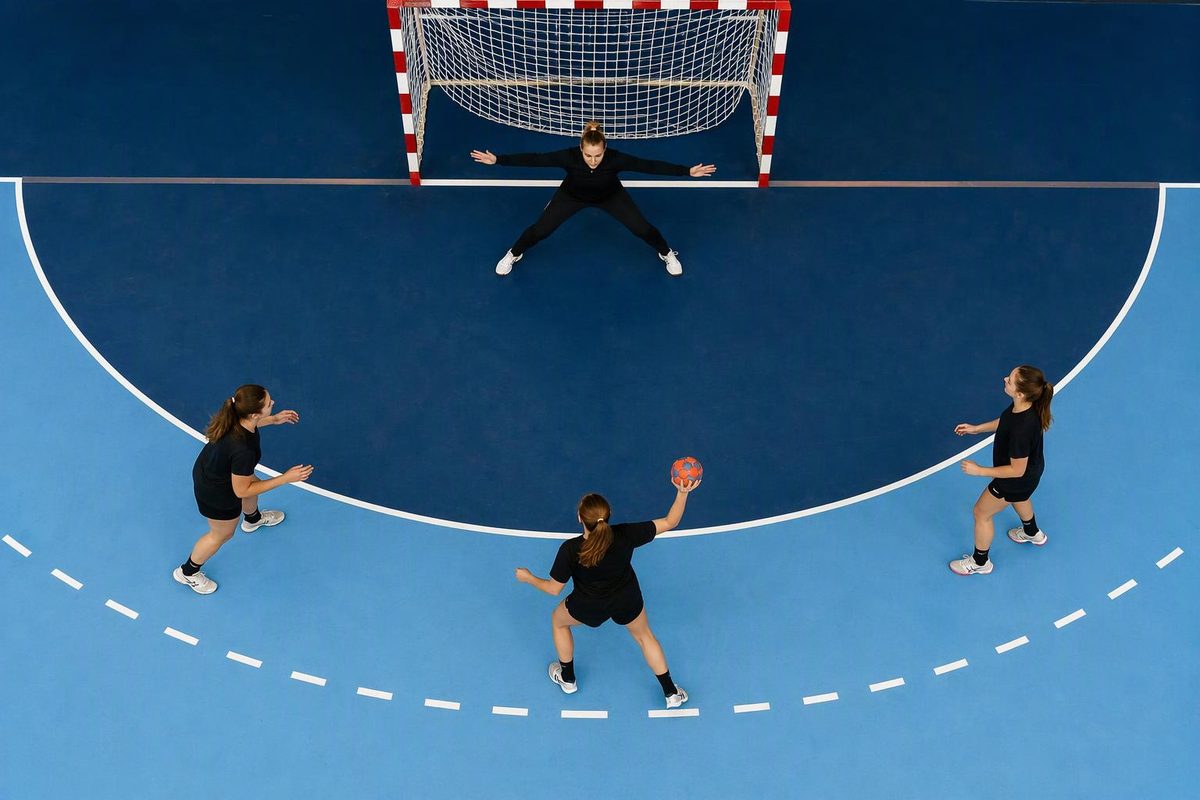
These handball goalie drills need one goalkeeper, three court players, one goal and 25 minutes. Use them when the keeper needs focused work but you cannot spare a full shooting group. The progression moves from tracking the ball to controlled saves, then adds an unknown shooter and an outlet pass.
Who it suits: older youth and adult club players, with a beginner-to-intermediate goalkeeper and court players who can place controlled throws. This is a technical block, not a full match-intensity practice or a rehabilitation plan.
Equipment and space: four suitable handballs, three cones and half a court. Check that the goal is secured and the floor is dry and clear. Keep spare balls beside—not inside—the goal area. With a larger squad, other players can work on small-squad passing drills, but only if you have separate space clear of the shooting and outlet lanes.
| Block | Time | Task |
|---|---|---|
| Progressive warm-up | 7 min | Move, set and meet controlled throws |
| 1. Track and freeze | 6 min | Find a balanced position before release |
| 2. Two-height saves | 6 min | Respond and recover without rushing |
| 3. Read, save and pass | 6 min | Identify the shooter and use possession |
The timings include feedback and recovery. Allow only one shot at a time; the next shooter waits for the goalkeeper’s ready signal. Retrieve loose balls between sets. Never deliberately aim at the face, and do not require beginners to attempt splits or unfamiliar floor saves. Pause shooting if balance or recovery deteriorates.
Warm-up: movement before shooting — 7 minutes
First three minutes: all four players use easy jogging, side steps, comfortable dynamic ankle, hip and shoulder movements, and gentle passing. Gradually increase movement speed and throwing effort.
Next two minutes: the goalkeeper moves across the goal using short side steps. On a passer’s signal, stop in a balanced stance with softly bent knees and hands visible while watching the ball. Add easy catches from outside the goal area.
Final two minutes: take short sets of controlled throws from about 8–9 metres. Start within comfortable reach, then vary the placement enough to require a small adjustment. Reset after each throw.
Wojciech Nowiński’s introductory manual, hosted by Olympic Handball Ireland, includes joint preparation, goalkeeper-specific movement, varied saves and counterattack passing in its warm-up guidance. Its basic stance guidance also emphasises bent legs and keeping the hands visible while watching the ball. See Goalkeeper — the first steps.
Watch: can the keeper move, stop and catch without stumbling? If not, keep the throws gentle and spend longer here rather than forcing the later stages.
1. Track and freeze — 6 minutes
Setup: place a cone for each court player at left back, centre back and right back, around the 9-metre line. Give them one ball.
Action: pass between the three positions for 30–40 seconds. The goalkeeper follows the ball with short adjustments, keeping the chest and head facing it. Initially, nobody shoots.
Next, let a receiver show a throwing action and hold the ball. Freeze everyone there so the coach can check the keeper’s position. Finally, allow a gentle shot after at least three passes.
Watch: is the keeper positioned relative to the ball, rather than waiting on a fixed spot in the middle of the goal? Are they balanced when the shooting action begins?
EHF’s interview with goalkeeper coach Mattias Andersson identifies situation-specific positioning as the foundation, while stressing that positioning and technique should suit the individual goalkeeper. Avoid insisting that every keeper copy the same stance or movement size. Read the EHF coaching discussion.
Make it easier: slow the passes and remove shots. Progress: vary the passing order before increasing shot speed.
2. Two-height saves — 6 minutes
Setup: one shooter stands centrally at 8–9 metres. The other two players retrieve balls between sets and observe from outside the shooting lane. Rotate these roles after each set.
Action: take four shots per set. Choose two reachable targets—for example, high left and low right—and announce the order beforehand. Name left and right from the goalkeeper’s perspective. In the next set, use high right and low left. Allow a reset between attempts and a short feedback break after each set.
Use the save movements the keeper already knows; the aim is controlled execution, not maximum reach.
Watch: after each attempt, can the goalkeeper return to a balanced ready position without an extra stumble? Count controlled recoveries rather than saves.
Make it easier: reduce placement width and throwing pace. Progress: let the shooter choose between the two practised targets for that set without announcing which. Change uncertainty before adding power.
3. Read, save and pass — 6 minutes
Setup: put two passers at left and right back around 9 metres. The third player is an outlet—a teammate receiving the keeper’s pass—in a wide lane 12–15 metres from goal.
Action: the back players exchange at least two passes; either may then shoot at controlled pace. After gaining possession, the goalkeeper looks up and passes to the outlet moving towards halfway. If the shot rebounds, secure the ball first. If no possession results, reset; do not force an outlet from every attempt.
Run sets of four shots. The outlet returns to the starting position before the next attempt. During the break, rotate the three court-player roles and move the outlet to the opposite wide lane.
Watch: does the keeper follow the final pass rather than leave early? Once the ball is secured, does the outlet receive a catchable pass without stopping?
Make it easier: designate the shooter and keep the outlet stationary. Progress: restore the unknown shooter, then add the moving receiver—one change at a time.
Record two separate counts over the final four attempts: balanced positioning at release, and catchable outlets when possession is gained. Use the weaker task to choose the starting point next time. For a longer practice with 6–10 court players, wing shots and defensive cooperation, use the 65-minute goalkeeper session.