
Five Shooting Drills for a Small-Squad Handball Session
Build a 55-minute session for 6–10 handball players with five shooting drills progressing from controlled accuracy to defended decisions.
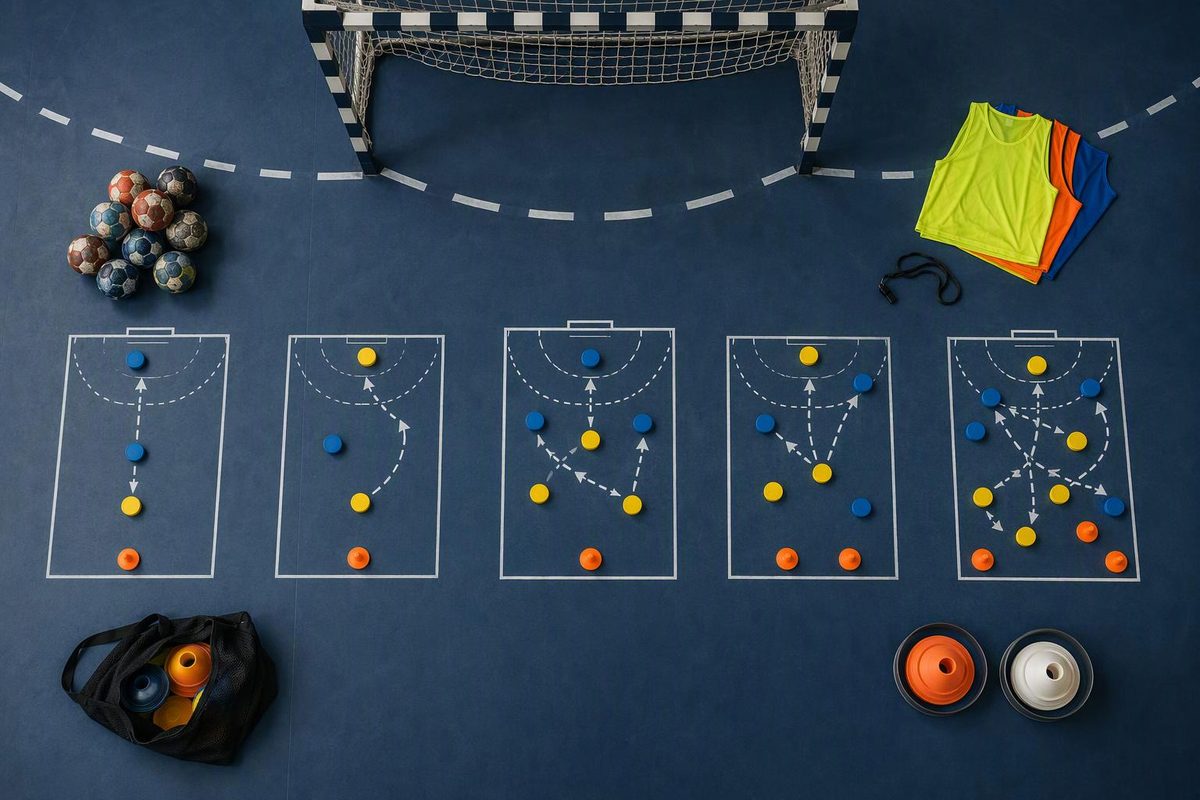
For 6–10 older youth or adult club players, including one goalkeeper, run these five shooting drills as a 55-minute progression from controlled accuracy to game-speed decisions. Use half a court, one goal, 4–8 balls, 6 cones and 4 flat markers after a progressive warm-up; players should already pass and catch reliably.
Enter your total player count to see the final-game format and full session timeline.
Small-Squad Shooting Session Planner
Use a whole number from 6 to 10.
Three-Pass Game Setup
3v3 plus one goalkeeper
All seven players are active. Both teams attack the same goal.
| Start | Drill | Time |
|---|---|---|
| 0 min | Four-corner accuracy | 8 min |
| 8 min | Three-step jump shot | 10 min |
| 18 min | Passive block | 10 min |
| 28 min | Two shooting gates | 12 min |
| 40 min | Three-pass game | 15 min |
Source: timings, player ranges and game formats in this practice plan. Step and goal-area rules: IHF indoor rules dated 1 March 2025.
Keep the same two or three coaching cues throughout the block. Change the approach, defender or scoring condition instead of stopping players for a new explanation at every stage.
The structure follows principles in the IHF’s school-handball teaching material: progress from simple to complex, provide many chances to practise and include game-like tasks. The same resource lists an elbow below shoulder height as one possible technical fault. That can help diagnose a weak throwing position, but it is not the automatic explanation for every miss (IHF, Teaching Handball).
Use Three Cues Throughout the Session
- Arrive balanced. The final foot contact or take-off should allow control of the throw and landing.
- Prepare the ball away from the defender. Do not carry it low into the shooting action.
- See the goalkeeper before release. Select an available space rather than throwing automatically at a pre-called corner.
For a basic right-handed jump shot, start with a left-foot take-off. Reverse this for a left-hander. If a player cannot coordinate the run-up, reduce it to one step before adding a three-step approach.
The IHF indoor rules dated 1 March 2025 allow a maximum of three steps with the ball. They also define the 6-metre line as part of the goal area, so mark the take-off clearly outside it (IHF indoor rules).
1. Four-Corner Accuracy for 8 Minutes
Setup: Put one marker about 8 metres from goal, slightly left of centre, and another slightly right. Form two queues with the balls between them. Identify four target zones: high and low on each side. Keep the queues far enough apart that their approaches cannot cross.
Action: Players take one controlled step and shoot. They collect a ball only when the shooting lane is clear, then join the other queue. Begin at about 70% power.
During the first minute, give the goalkeeper central, readable throws at a comfortable height. Then call a target zone. Award one point for the intended half of the goal and two for the intended corner zone. Change the target every two shots.
Checkpoint: Count shots that reach the selected zone, not goals. A central shot that beats the goalkeeper is still a poor repetition for this task.
Adjustment: Developing players throw from 7 metres or work without the goalkeeper. More advanced players receive a short pass immediately before shooting.
2. Three-Step Jump Shots for 10 Minutes
Setup: Keep the two queues. Reposition three markers to show the approach rhythm, with the final take-off outside the 6-metre line. A feeder stands centrally with the balls.
Action: The shooter starts moving before the pass, receives in stride and uses up to three steps before taking off and shooting. After landing, the shooter becomes the feeder. The previous feeder collects a ball and joins a queue.
Start without a corner command. Once the rhythm is stable, the feeder calls “near” or “far” while the pass is travelling. The shooter adjusts the release without adding a step.
Checkpoint: Watch the sequence from catch to take-off. If players catch, stop and then restart, shorten the pass and approach. For more detail on reception and planting, use this catch-to-take-off wing progression.
Do not chase jump height at the expense of control. A balanced release that the player can vary is more useful than an exaggerated jump followed by a poor landing.
3. Shoot Around a Passive Block for 10 Minutes
Setup: Mark a defender’s position 7–8 metres from goal. The defender holds a foam noodle or keeps both hands raised but does not step into the shooter. Use one shooting queue so the lane stays clear.
Action: The shooter receives from a central feeder and chooses one of three solutions:
- release above the block;
- lean to create a release outside it; or
- delay briefly and shoot beside the descending arms.
The defender changes arm position on each repetition but makes no contact. Rotate the defender after three shots.
Checkpoint: The ball should stay protected on the side away from the defender. Correct players who swing it across the defender’s reach or lose sight of the goal while trying to create an angle.
4. Read Two Shooting Gates for 12 Minutes
Setup: Mark two attacking gates, each about 1.5 metres wide, between 8 and 9 metres from goal. One defender starts between them. A feeder stands at centre back, and shooters begin 3–4 metres away.
Action: The shooter passes to the feeder, moves towards either gate and receives the return pass. The defender may close one gate but cannot tackle the shooting arm. The attacker must read the closure and either:
- shoot through the open gate;
- make one change of direction and shoot through the other; or
- pass back if neither lane is safe.
Rotate attacker to defender, defender to feeder and feeder to the queue.
Scoring: Award two points for a goal through the initially open gate, one for a safe reset pass and none for forcing a throw into the defender.
Checkpoint: Look for an early scan before the catch. If everyone decides in advance, have the defender start behind a cone and move only while the return pass is in flight.
Do not permit contact with an airborne shooter. The IHF rules identify actual loss of body control while running, jumping or throwing as a criterion for dangerous fouls. This drill develops reading under pressure, not collisions (IHF indoor rules).
5. Finish With a Three-Pass Shooting Game
Setup: Both teams attack the same goal, with the goalkeeper acting as a neutral. Choose the format by total attendance:
- With seven players, use 3v3 plus the goalkeeper.
- With six, play 2v2 plus the goalkeeper and rotate the spare player after each attack.
- With 8–10, play 3v3 and rotate the extras in after each shot or turnover.
Keep spare balls beside the goal for quick restarts.
Action: The attacking team has a maximum of three passes before it must shoot. A goal counts:
- one point from any legal shot;
- two points when the shooter receives while moving and finishes from a clear lane; or
- three points when the shooter changes the release to go around a block or a visible goalkeeper movement.
After a goal, save or turnover, the other team takes possession and attacks immediately. Play three rounds of three minutes with one minute for feedback between rounds.
Checkpoint: Judge shot selection as well as execution. Pause only for a repeated pattern: stationary receiving, shooting through a defender’s body or ignoring an open teammate. Otherwise, coach between rounds so the game retains its speed.
For a mixed group, give developing players a protected first reception or one extra pass. Give experienced players a weaker-side approach, a narrower gate or a late visual cue. Everyone stays in the same activity, but the decision has an appropriate level of difficulty.
Manage the Goalkeeper and Shooting Load
Warm the goalkeeper progressively: central, readable throws first; placed shots second; unrestricted shooting only after that. Never use the goalkeeper’s head as a target.
In the first two drills, limit each shooter to two consecutive efforts and keep the next player behind the approach marker. Nobody retrieves a ball until the active shot has finished.
Without a goalkeeper, mark four safe target zones and score accuracy. With two goalkeepers, alternate them every four to six shots rather than leaving one in goal for the whole block.
End or simplify the activity when throwing mechanics or landings deteriorate. Rushed shots are not a useful progression.