
Six Goalkeeper Drills From Positioning to Match Decisions
A 65-minute goalkeeper session for one goal, 6–10 court players and half a court, progressing from positioning to saves, outlets and live decisions.
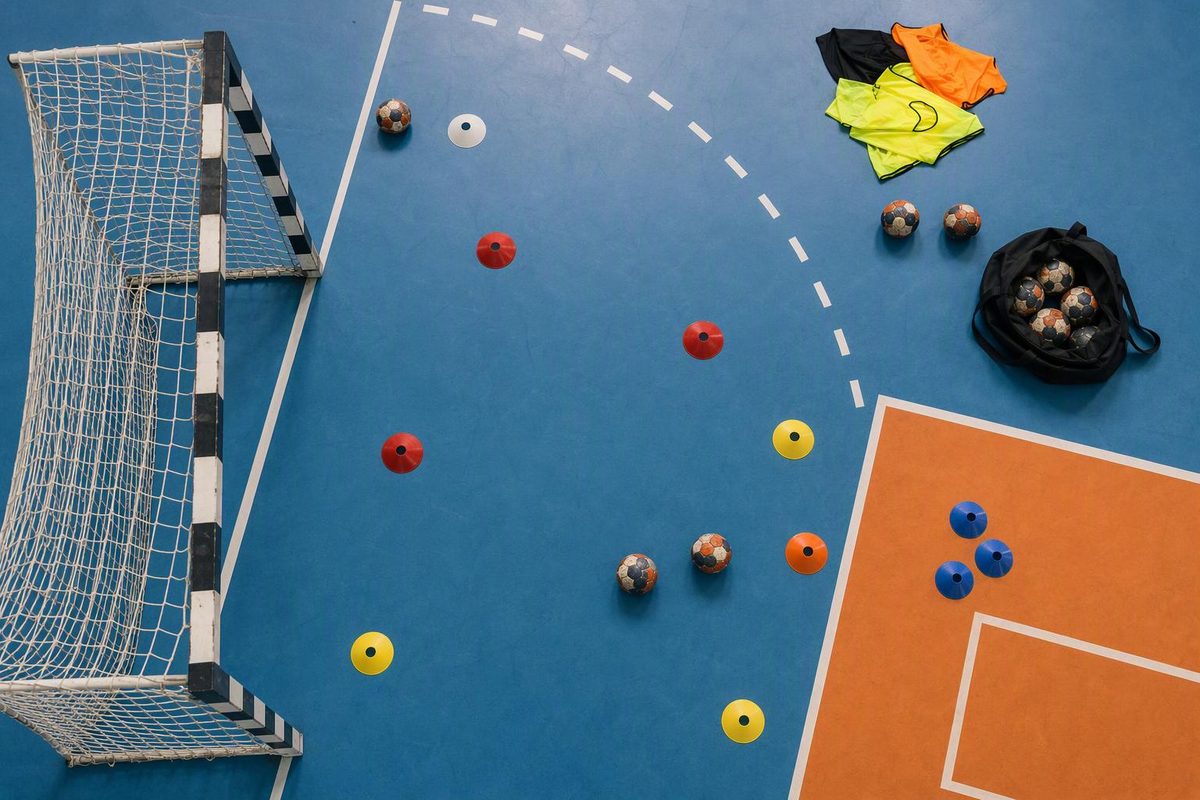
This goalkeeper session progresses from footwork and positioning to back-court shots, wing shots and breakthroughs, then finishes with save-to-counterattack play. It is designed for one goalkeeper and 6–10 court players, using one goal, half a court and 8–12 balls.
The plan suits older youth and adult club players who can shoot with reasonable control. For a less experienced goalkeeper, reduce shot speed, keep early attempts within reach and delay the choice-based stages. With two goalkeepers, alternate every four to six shots so neither stands inactive for a long block.
Session at a glance
| Block | Time | Main outcome |
|---|---|---|
| Goalkeeper-specific warm-up | 10 min | Ready position and controlled movement |
| 1. Follow the ball and set | 8 min | Position before the shot |
| 2. Four-zone saves | 10 min | Save movement and balanced recovery |
| 3. Read the final pass | 10 min | Move, stop and react |
| 4. Wing-angle saves | 10 min | Close the near-post space without guessing |
| 5. Breakthrough plus defender | 10 min | Positioning and defensive cooperation |
| 6. Save and release | 7 min | Turn possession into an accurate outlet |
Use short working sets with enough time for the goalkeeper to reset. If save shape or recovery deteriorates, pause the shooting rather than turning the technical block into conditioning.
Warm-up: movement before shots — 10 minutes
Use the first four minutes for the whole squad’s progressive movement and ball warm-up. Include the ankles, knees, hips, shoulders and elbows. The goalkeeper then works in the goal while the court players continue easy passing:
- Move between the posts with small side steps, stopping in a balanced ready position on the coach’s signal.
- Add controlled high, middle and low catches from 5–6 metres.
- Finish with short sequences of four varied shots, all within comfortable reach.
Begin with soft throws and increase the pace gradually. Do not deliberately target the face. The Irish Olympic Handball Association’s introductory goalkeeper manual likewise moves from joint preparation and goalkeeper-specific movement to varied saves, shots from playing positions and counterattack passing (Goalkeeper — the first steps).
Watch for: the goalkeeper’s feet still moving when the throw begins. They should arrive, become balanced and then react.
1. Follow the ball and set — 8 minutes
Setup: Put three passers across the 9-metre line at left back, centre back and right back. They pass in any order. Begin without shooting; the other players rotate in after each 45-second round.
Action: The goalkeeper moves with the ball and resets after every pass. Next, allow any receiver to show a shooting action without releasing. In the final rounds, permit a controlled shot after at least three passes.
The goalkeeper’s reference is the ball, not the passer’s starting cone. Use economical side steps, keep the head and chest facing the ball and avoid crossing the feet during short adjustments.
Checkpoint: Freeze play just before a shot. Is the goalkeeper balanced and aligned with the ball and the centre of the goal?
Positioning comes before spectacular save technique. Germany goalkeeper coach Mattias Andersson describes situation-specific positioning as the most important foundation and stresses that technique and positioning should be adapted to the individual goalkeeper (European Handball Federation).
2. Four-zone saves — 10 minutes
Setup: Form one shooting line at centre back, 8–9 metres from goal. Divide the goal mentally into high left, low left, high right and low right, always named from the goalkeeper’s perspective.
Action: Work in sets of four. The coach names the sequence before the shots—for example, high left, low right, low left, high right. Shooters use a controlled pace and wait until the goalkeeper has recovered before beginning the next approach.
After two sets, stop naming the order. The shooter may choose any of the four zones but must hit a reachable target rather than trying to score at all costs.
Coaching cues:
- Start balanced, with the knees softly bent.
- Move the hand and leg on the ball side together when that matches the goalkeeper’s chosen technique.
- Take the body towards the ball rather than collapsing away from it.
- Land under control and recover through the ready position.
Checkpoint: Count balanced recoveries, not saves. A touch followed by an uncontrolled fall across the goal is not yet a repeatable action.
3. Read the final pass — 10 minutes
Setup: Use the same three back-court positions. Give one ball to the centre back.
Action: The three attackers pass freely. After at least two passes, either outside player may shoot. Once the goalkeeper starts leaving the centre early, also allow the centre back to shoot.
This removes the known shot location while preserving enough control for technical work. Ask attackers to use credible passing and shooting approaches rather than giving the decision away with a different run-up.
Checkpoint: Does the goalkeeper continue moving after the shooter begins the throwing action? If so, slow the passing and reinforce: arrive, set, save.
4. Wing-angle saves — 10 minutes
Setup: Place one passing line at centre back and shooting lines on both wings. Alternate sides every two shots.
Action: The centre back passes to a wing moving into the catch. The goalkeeper adjusts towards the post and faces the release point. Begin with controlled shots towards the near side. Then allow the wing to choose the near side, far side or lob.
The first objective is to remove an easy near-post finish through positioning. If the goalkeeper advances, it should be a deliberate response to the shooter and release point—not an automatic charge on every repetition.
Checkpoint: Watch from behind the wing. Before release, is there a clear near-post gap caused by the goalkeeper arriving late or stopping in the wrong place?
If the attackers need work on receiving and taking off from this position, use the wing run-up timing progression.
5. Breakthrough plus defender — 10 minutes
Setup: Put one attacker at centre back, one defender around 8 metres and one feeder to the side. Mark a narrow attacking channel with cones. Spare players queue behind the attacker and rotate through attacker, defender and feeder roles.
Action: The feeder passes to the attacker, who tries to beat the defender and finish from 6–7 metres. The defender applies realistic pressure but does not tackle from behind. The goalkeeper reads the attacker’s route, the defender’s pressure and the shooting space that remains.
Before the block, ask defender and goalkeeper to agree one simple principle. For example, the defender tries to deny the shooter’s throwing-arm side while the goalkeeper prioritises the other side. This is a training agreement, not a universal defensive rule.
Andersson recommends integrating goalkeeper work into team practice because situations such as breakthroughs and cooperation with defenders cannot be trained fully in isolation (European Handball Federation).
Checkpoint: After selected repetitions, ask: “What did the defender remove?” The goalkeeper should answer before discussing the save itself.
6. Save and release — 7 minutes
Setup: Keep two shooters at 9 metres. Put two outlet players near halfway, one in each wide channel. The remaining players retrieve balls and rotate into the shooting and outlet roles.
Action: A shooter takes a controlled shot. On a save or clean collection, one outlet accelerates and the goalkeeper passes into their running path. If the ball rebounds, the goalkeeper secures it before looking upfield; speed does not excuse a rushed pass. Alternate the active outlet so the goalkeeper must scan rather than follow a fixed pattern.
Award one point for a save or controlled collection and another for an outlet caught in stride. This makes the action after the save part of the drill instead of ending every repetition at the goal line.
Final checkpoint: Across the last six shots, look for three things: balanced positioning at release, a controlled first action after the save and an outlet that lets the receiver continue forward. These are more useful measures for this cooperative session than save percentage.