
From Wheelchair Basketball to Handball: Train the Pass and the Space
A 50-minute wheelchair-handball introduction for six experienced chair users, with passing progressions, spacing cues and no-contact games.
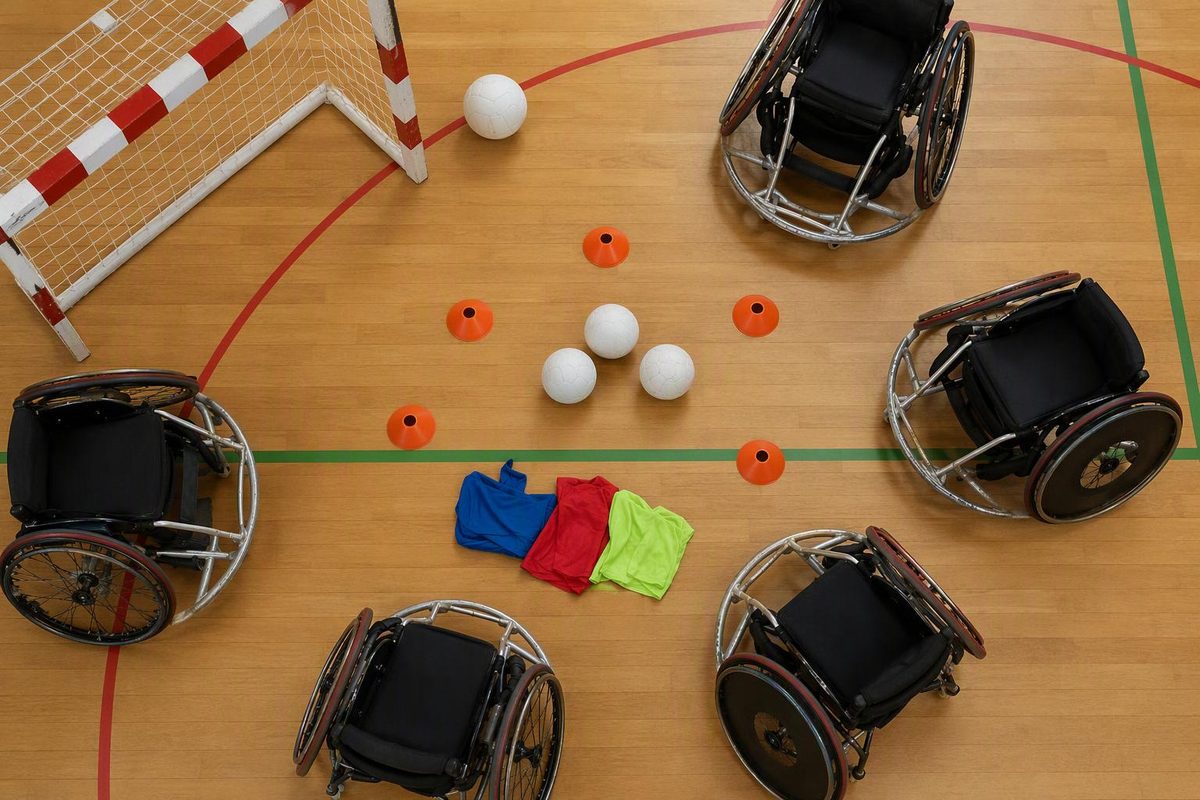
For players moving from wheelchair basketball to wheelchair handball, start with chair control, scanning and creating passing lanes—then teach handball’s ball-handling rules separately. Do not assume that an experienced basketball player already knows how to move legally with a handball.
There are useful elite examples. In its 20 September 2026 profile of Shinnosuke Morooka, the IHF reported that roughly half of Japan’s squad also played wheelchair basketball. It described the federation’s deliberate cross-training approach as supporting wheelchair handling and court awareness. Morooka credited teammates with spreading the court and creating space. That is an attributable coaching example, not proof that cross-training caused Japan’s results.
Spain’s Agustín Alejos offers another transition example: the IHF’s 21 September 2026 profile reported that the experienced international wheelchair-basketball player won the 2026 wheelchair-handball world title in his first official competition in the sport. His pathway is encouraging, but not a timetable for beginners.
Who this session is for
This is a coach-designed, 50-minute passing-and-spacing introduction, not a federation session or a complete conversion programme.
- Players: six adults who already handle sports wheelchairs confidently but are new to handball; mixed handball ability is fine.
- Space: half a hall, with a suggested 12 × 16 m activity rectangle and clear surrounding space. Reduce speed if turning and stopping room is inadequate.
- Equipment: six sports wheelchairs checked for suitability by the wheelchair-handball coach, three handballs selected for comfortable control without resin, flat markers and bibs.
- Staff: a coach competent in wheelchair-handball safety and rules, or a handball coach working with a wheelchair-handball coach.
- Contact: none throughout. Defenders intercept passes; they do not challenge the player or chair.
If players are also learning chair propulsion, braking or turning, use a separate introductory session first.
Before starting: chair safety and the rule reset
Check chair condition, individual positioning, straps and anti-tip equipment with the wheelchair-handball coach and player. Do not assume that a basketball chair automatically meets handball requirements. Keep bags and loose balls outside the activity area. Agree a stop signal and assistance procedure; stop all movement if a player falls or a ball becomes trapped under a chair.
The IHF four-a-side rules, dated 1 July 2026, specify chair safety requirements and upper- and lower-leg straps. They also prohibit dangerous contact, holding an opponent’s chair, and side or rear contact. This session’s no-contact condition is deliberately stricter than match play.
Teach Rule 12 before adding pressure:
- The ball may be held for a maximum of three seconds.
- It may be placed on the lap, not between the knees, while pushing for a maximum of three seconds.
- After the hand leaves the wheel, the next action—dribbling, passing or shooting—must follow within three seconds. The rule says the player cannot touch the wheel again after those three seconds.
- The rule’s comments state: “After receiving the ball, the player has to start the action by bouncing.”
Demonstrate receiving, bouncing, then passing or moving with the wheelchair-handball coach rather than importing basketball’s handling routine. Apply this teaching throughout, including stationary passing, and use the same rulebook for corrections.
The 50-minute progression
0–8 minutes: warm up, scan and stop
Use the whole activity rectangle. Begin with comfortable propulsion, controlled stops and broad turns without a ball. Keep separate travel paths; no races or sharp turns through traffic.
Then work in three pairs. One player shows a left or right signal; their partner looks up, identifies it and turns towards that side. Finish with short, stationary passes at a distance both players can manage.
Watch: can the player look away from the travel path briefly, then stop within clear space? If not, keep the next block stationary and slow.
8–18 minutes: pass, then create a new lane
Make two triangles, each with three players and one ball. Start with stationary passing in either direction. After passing, the player repositions a short distance into empty space; the other two maintain useful separation.
Progress to receiving while moving slowly, using the ball-handling sequence demonstrated earlier. Do not make constant movement compulsory if it prevents controlled catches.
Cue: “Show a target before the pass; find new space after it.”
Checkpoint: look for five consecutive controlled receptions without two chairs converging on the same space. Widen the triangle or shorten passes before increasing speed.
18–30 minutes: three attackers against two interceptors
Use one rectangle. Three attackers keep possession against two defenders; the sixth player rests and observes. Rotate roles every 60–90 seconds so everyone takes turns attacking, defending and resting.
Defenders begin by closing passing lanes slowly, staying clear of the ball carrier’s chair. Attackers score a training point for three completed passes. There is no minimum movement distance and no reward for speed alone.
Progress by allowing more active interceptions—not contact—when catches and legal ball movement remain controlled.
Watch: does the off-ball attacker move out from behind a defender before the carrier needs to release? If the carrier repeatedly has no option, pause and reposition the receivers rather than demanding a harder pass.
30–45 minutes: three-against-three end-zone game
Mark a receiving zone about 2 m deep at each end of the rectangle. Score one training point by completing a controlled pass to a teammate in the opposite zone. The receiver must start outside the zone and enter to receive; nobody waits there permanently. Defenders stay outside both zones.
After a point, the other team restarts from its own end with opponents giving space. After an interception, the new attacking team plays towards the other end. For an out-of-bounds pass or ball-handling violation, stop movement and give the other team a stationary restart at that location, with opponents clear.
Apply the taught ball-handling rules and retain the no-contact restriction. This is a modified training game, not official four-a-side wheelchair handball. Keep the same six players involved, with brief pauses for rest and corrections.
Cue: “One player offers width; another offers depth.” Here, depth means an option further up the playing area, not three attackers in a flat line.
45–50 minutes: slow down and review
Return to comfortable chair movement and short passing. Ask each player to identify one moment when moving without the ball helped a teammate.
Record three observations: controlled receptions, ball-handling violations and possessions where the carrier had no clear pass. Use those observations to choose the next session’s priority. Add shooting and goalkeeper work separately, with appropriate equipment and wheelchair-handball coaching support.
If you coach standing handball
Borrow the decision task, not the wheelchair mechanics: look before receiving, create a second passing option and move again after releasing. Run the triangle and overload blocks on foot under standing-handball rules. Do not use ordinary chairs to imitate wheelchair sport. For a standing-squad progression, use these passing drills for small squads.