
Beach Handball: Rules and a 60-Minute Starter Session
Teach beach handball with the key rules and a 60-minute sand session for 8–10 adult players, progressing from passing to four-a-side games.
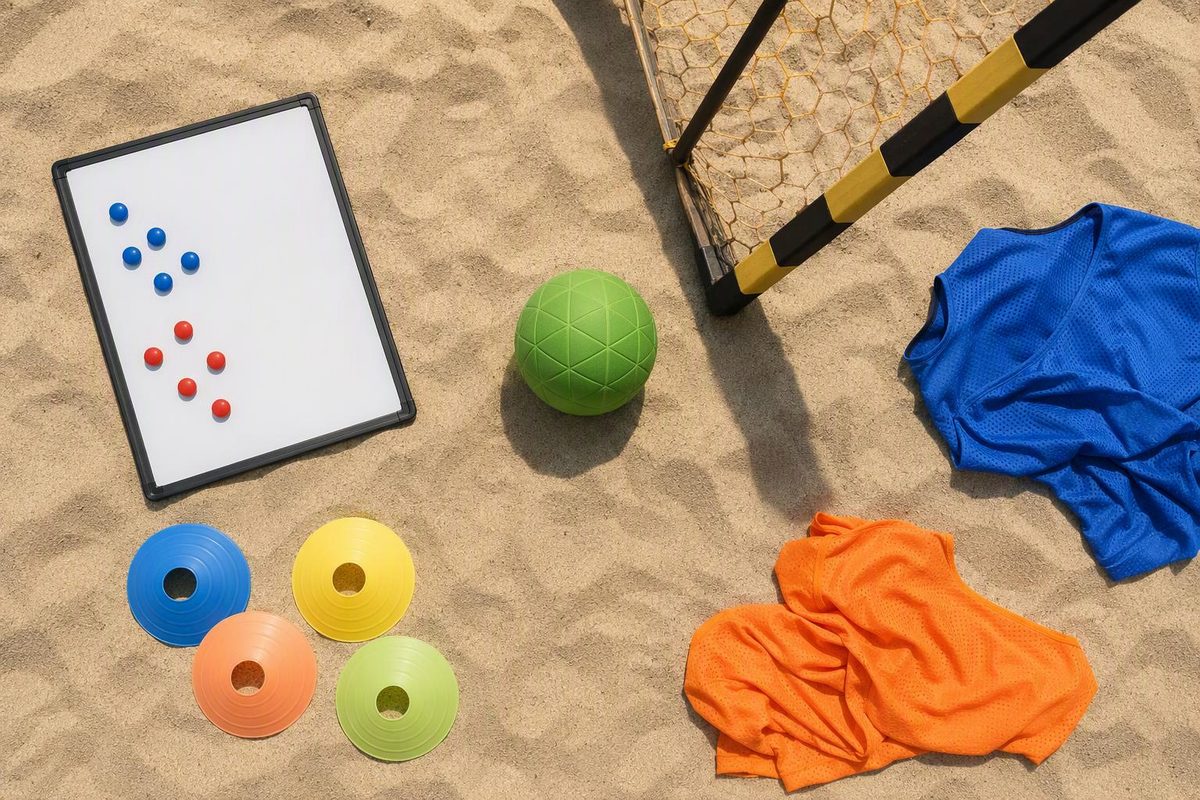
Beach handball is four-a-side handball on sand, with one- and two-point goals and separately scored periods. For an indoor club’s first session, teach secure catches, spacing and goalkeeper involvement before asking players to attempt spectacular finishes.
This 60-minute introduction is for 8–10 adult players who can already pass and catch but are new to sand. It uses two goals and includes two players willing to take goalkeeper roles. The drills and shortened games below are training adaptations, not a regulation match.
The beach handball rules to teach first
These essentials follow the March 2026 IHF rulebook, including amendments effective from 1 April 2026.
- Court and players: the court is 27 × 12 metres, with a straight goal-area line 6 metres from each end. Each team has up to four players on court: three court players and one designated goalkeeper. Under IHF rules, teams must have at least six players present at the start, so two four-player practice groups are not sufficient match squads.
- Possession: players may hold the ball for up to three seconds and take up to three steps. Bouncing or rolling the ball on the sand is permitted under the ball-handling rules; this session uses passing rather than dribbling.
- Goal area: court players must take off outside the goal area, without touching its line, and release before landing inside it. Entering after playing the ball is allowed only if it does not disadvantage opponents.
- Contact: beach handball is not entirely non-contact. Legal frontal body contact with bent arms is permitted; holding, pushing and running or jumping into opponents are not. Use a stricter, no-contact condition for this introduction.
These provisions are in IHF Rules 1, 4, 6, 7 and 8.
Scoring changes the decisions. Ordinary goals earn one point; creative or spectacular goals, goalkeeper goals and goals from 6-metre throws earn two. An in-flight finish means receiving, controlling and shooting the ball while airborne; merely slapping or pushing it into goal earns one point. Do not award two points simply because a player jumps. See Rule 9 and Clarification 1.
A regulation game has two separately scored 10-minute periods, with a five-minute interval. A tied period goes to golden goal—the next goal wins. Winning both periods wins the match 2–0; splitting them leads to a shoot-out. After a goal, play restarts with a goalkeeper throw, not a centre throw. IHF Rules 2 and 9
One current rule worth teaching: after the passive-play warning, the attack has a maximum of four passes to attempt a shot. That is not a four-pass limit on every possession. The IHF’s April 2026 amendments also prohibit repeatedly delaying restarts.
Set up before the clock starts
Use a prepared sand court, two safely anchored goals, flexible court markings, bibs and four non-slippery rubber beach-handball balls. Give the two designated goalkeepers different bib colours, distinguishable from both teams’ court players.
Inspect the surface and anchors before players enter. IHF court specifications require level sand free of rocks, shells and other hazards, at least 40 centimetres deep, and recommend a three-metre surrounding safety zone. Players play barefoot; short, regular cloth sports socks or support bandages are permitted, but sand socks and synthetic or rubber footwear are not. IHF Rules 1, 3 and 4
Build water and recovery pauses into each block. Stop if the surface or weather becomes unsafe. If you only have a hall, use the club’s small-squad passing progression instead; do not rehearse sand dives on a hard floor.
The 60-minute progression
0–10 minutes: movement and controlled catches
Make four pairs with eight players, three pairs and a trio with nine, or two pairs and two trios with ten. Use one ball per group and include the goalkeepers. Begin with walking passes, then easy jogging, lateral movement and controlled stops. In trios, alternate receivers. Add a few low jumps without the ball only when players can land steadily.
Watch: can the receiver stop without stumbling and catch without chasing the pass? Shorten the distance before increasing speed. Keep dives and spinning shots out of this block.
10–20 minutes: pass, move and find space
Make two groups of four in separate parts of the central playing area. With nine or ten players, use groups of four and five, or two fives.
Start with unopposed passing: after releasing, move to a new passing angle. Progress to three attackers against one interceptor; a five-player group uses four attackers against one. Change the defender every minute. Use no dribbling and no contact.
Watch: receivers should look before the ball arrives and offer a clear target. If two attackers occupy the same passing lane, pause and separate them. Progress only when passes remain catchable under interception pressure.
20–32 minutes: catch, approach and finish
Split between the two goals. At each end, use one goalkeeper and rotate the others through feeder, shooter and ball-retrieval roles. Keep spare players outside the shooting lane.
Start with controlled standing shots from outside the goal area, then receive while moving and finish with a small jump. Take off outside the goal-area line, release before landing, and leave the landing space clear. Aim away from the goalkeeper’s head.
For more capable players, add a low, unopposed in-flight catch-and-shot. Others keep the moving catch and ordinary finish; both choices remain available later.
Watch: if the player reaches for the catch or loses control on landing, reduce the pass distance and return to the simpler finish.
32–44 minutes: use the goalkeeper to create four against three
Use one end: four attackers face three court defenders and a goalkeeper—eight active players. Any extras rotate into court-player roles between attacks.
One attacker is the attacking team’s designated goalkeeper, now participating outside the goal area. The goalkeeper may leave the area without the ball and then receive in the playing area; they may not carry a controlled ball out. This follows IHF Rules 4 and 5. Reset after each shot or turnover; swap attacking and defending groups halfway through.
Begin with defenders intercepting only. Then allow them to close space and block shots without contact. Score ordinary finishes as one and designated-goalkeeper finishes as two.
Watch: does the attack find the free player, or force the ball to the two-point scorer? Encourage the open shot rather than an extra pass into pressure.
44–60 minutes: shortened four-a-side games
Use the full court, with three court players and a goalkeeper per team. Allow two minutes to organise, play two six-minute periods and take a two-minute break between them. With extra players, rotate court substitutes through each team’s own substitution side, entering within the central playing area only after the outgoing player has left. See IHF Rules 1 and 4.
Keep the no-contact condition and restart goals with goalkeeper throws. The goalkeeper passes out from the goal area before joining the attack without the ball. Score the periods separately; record a tied period as drawn for this practice rather than extending the session into golden goal or a shoot-out.
Final checkpoint: look for three things—secure moving catches, a legal release before landing in the goal area, and a clear passing option after each goalkeeper restart. If those hold under pressure, introduce more demanding finishes in the next session.