
Not Looking at the Ball When Shooting: What to Coach
Teach handball players to secure the catch, look up and choose a shot with an 18-minute progression for six court players and an optional goalkeeper.
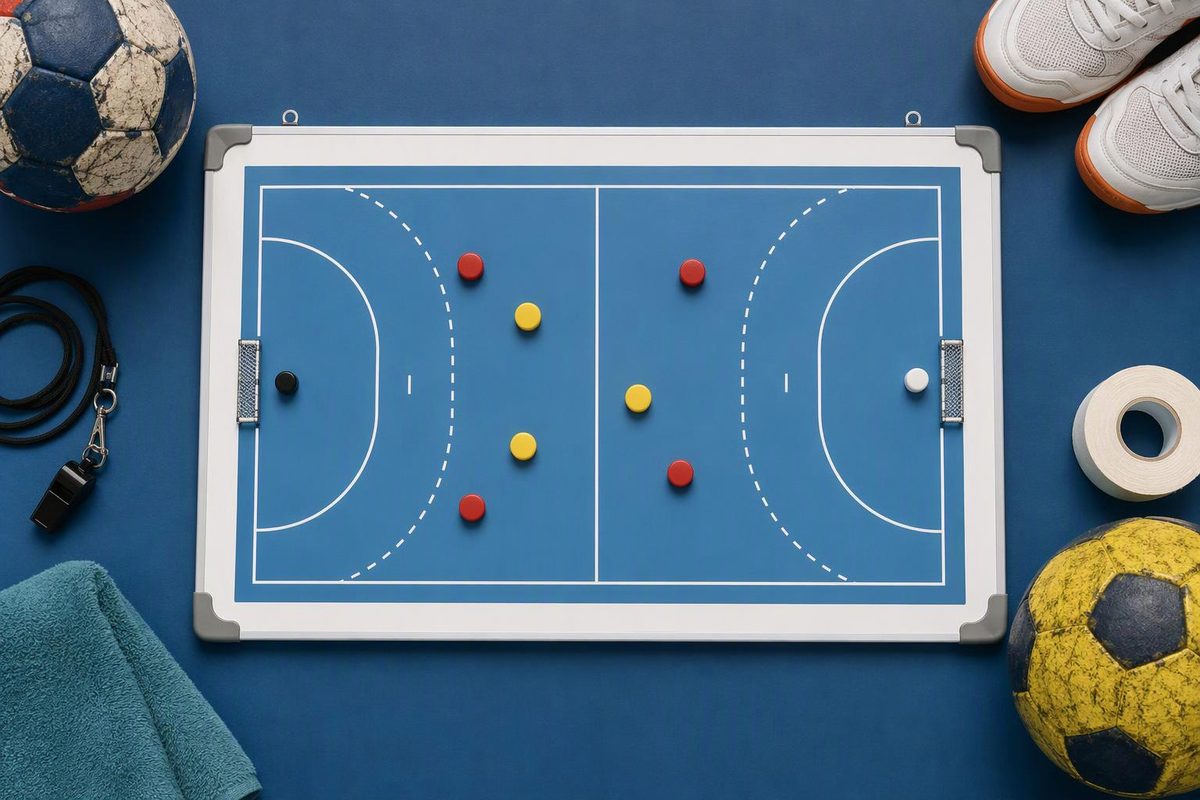
Once the ball is securely controlled, coach the shooter to read the goal and goalkeeper rather than watch the ball in their hand. Not looking at the ball when shooting is therefore usually the aim—not a fault. But looking away before completing the catch is a different problem.
The IHF’s Teaching Handball school guidelines say players should perceive their own position, teammates, opponents and goalkeeper rather than concentrate only on the ball. Secure ball handling helps make that possible. IHF teacher guidelines
A useful starting cue is: “Secure the catch, see the goal, choose your space.” This means looking up, not deliberately making a no-look shot or staring at one spot throughout the action.
Separate the catch from the shot
Watch several comfortable, unopposed attempts before changing anything:
- The player drops passes while looking towards goal: work on completing the catch. The EHF’s Basic Handball Methods explicitly advises keeping eyes on the ball until it has been caught. EHF catching guidance
- The player catches cleanly but then looks down at their grip: check whether they can hold and prepare the ball comfortably. The IHF recommends a ball size suited to the player’s hands. Slow the task before adding pressure. IHF ball-handling guidance
- The player looks up but repeatedly misses: do not assume an attention problem. Check the approach, balance and release using the shooting-form checklist.
- You are unsure whether the player notices the goalkeeper: introduce a decision task rather than simply asking for harder shots.
Head direction is a useful coaching clue, not proof of exactly where the eyes are focused. Ask occasionally, “What did you see?” Use the answer alongside the action, not as a test of attention on its own.
An 18-minute catch-to-shot block
For: teenage or adult club players who can already catch and throw comfortably. Players: six court players; an optional, warmed-up goalkeeper. Space and equipment: half a hall, one secured goal, two or three suitable balls and cones.
Run this after a progressive movement and throwing warm-up. Use one shooting lane, keep waiting players outside it and collect loose balls between turns. Start with grounded shots from a comfortable distance outside the goal area; add jump shots only for players who already control their take-off and landing. Keep shooting effort controlled when introducing the goalkeeper, and do not use the keeper’s head as a target.
This is a suggested club progression, not a published federation session. It draws on the EHF’s guidance to increase shooting speed gradually and the IHF’s emphasis on combining technique with game understanding. EHF shooting guidance · IHF teaching approach
1. Catch, look up, aim — 5 minutes
Leave the goal empty. One player feeds from the side; the others take turns shooting and rotate through the feeder role.
After the shooter secures the catch, the coach points towards the left or right half of the goal. The shooter identifies that side and throws there at controlled effort.
Watch: does the player finish the catch before looking up, then prepare the shot without repeatedly checking their hand?
Adjust: allow a brief pause if needed. Progress to receiving in stride only when the catch stays secure. Do not shrink the target yet.
2. Choose a target — 6 minutes
Remove the coach’s signal. With an empty goal, each shooter chooses a target area, shoots and says afterwards where they intended the ball to go.
If a goalkeeper is available, let them vary their starting position and attempt saves. Ask the shooter after selected attempts: “Where was the keeper, and which space did you choose?” Without a keeper, this remains an aiming task—not goalkeeper-reading practice.
Watch: distinguish a sensible target choice from accurate execution. A save alone does not establish that the choice was wrong.
3. Shoot or pass — 7 minutes
Use two attackers against one no-contact defender, with a feeder starting each repetition. Mark two starting positions outside the goal area, far enough apart that the defender cannot cover both attackers at once. Rotate roles every few attacks; the remaining court players wait outside the lane. Keep the goalkeeper if available.
The defender moves to close one attacker’s route without pushing or grabbing. Attackers may shoot when space is available or pass to the teammate. End each repetition after a shot or turnover.
Watch: can the ball carrier identify the defender and available teammate without losing control? If they rush, look down or force blocked shots, reduce defensive pressure.
Decide whether to progress
During the block, sample five turns per player. Note secure catches, useful information reported and whether the chosen shot or pass matched the available space. Treat this as a coaching checkpoint, not a validated score.
Progress individual players when those behaviours remain repeatable. If looking up brings back dropped catches or grip checks, simplify the feed or approach—not just the instruction.