
Handball Goalkeepers: Coach the Role, Not Just the Save
Integrate goalkeepers into club training with clear positioning cues, defender cooperation and a 20-minute block for one keeper and four court players.
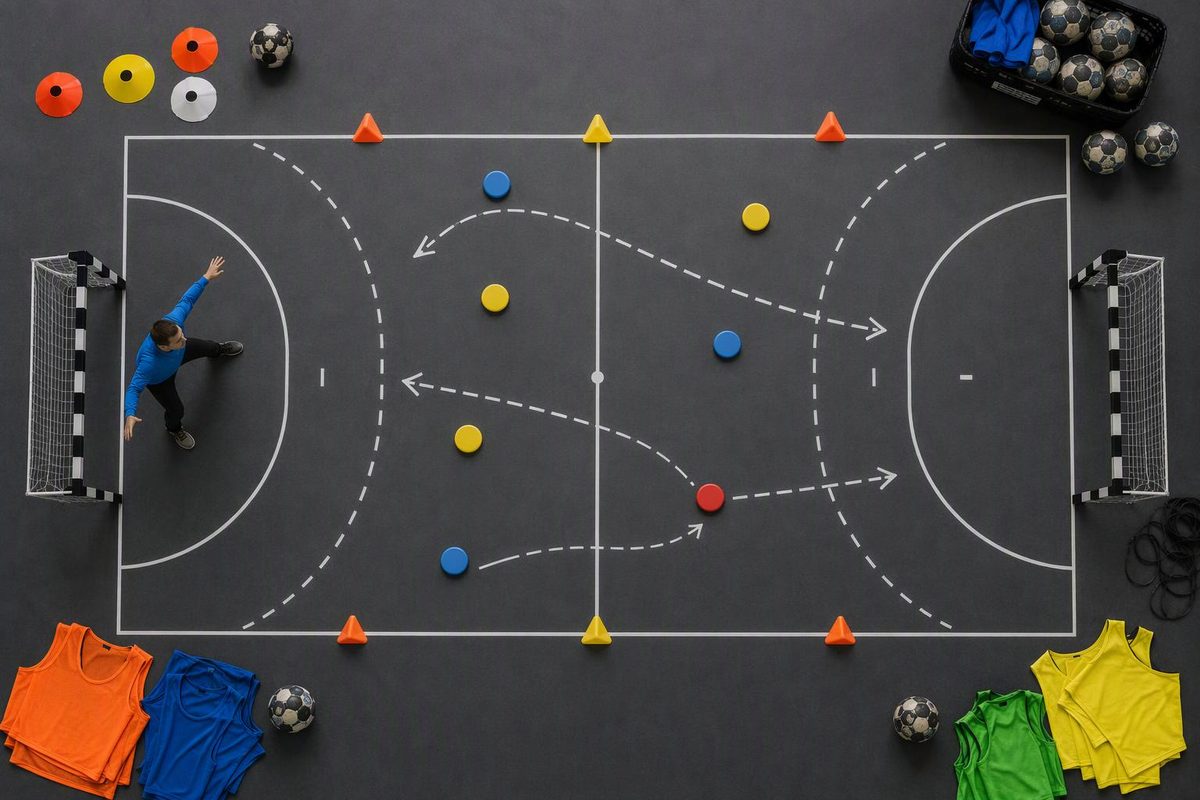
Give your handball goalkeeper a task beyond stopping the next shot: adjust to the ball, work with the defender and find a useful first pass after gaining possession. A shooting queue can provide repetitions, but it does not automatically train those decisions.
For adult beginner-to-intermediate squads, start with one observable target at a time. Use the 20-minute team block below after a progressive warm-up, rather than asking the keeper to face every shooting exercise at full speed.
What to watch before and after the save
Positioning: Does the keeper adjust as the ball moves, or stay in the middle regardless of the shooting angle? Watch whether they are balanced enough to respond at release, rather than still moving across the goal.
Do not prescribe an identical stance or distance from the goal line for everyone. In an EHF interview on positioning and technique, goalkeeper coach Mattias Andersson stresses that positioning must suit both the game situation and the individual keeper’s physique and abilities.
Cooperation: Does the keeper know what the defender is trying to cover? Agree a simple instruction before each sequence, then check what actually happened. A defender’s intended block is not a guarantee that the ball cannot travel that way.
Possession: Once the ball is controlled, does the keeper look for an available teammate rather than automatically throwing long? Coach the receiver’s movement too: an outlet pass—the first pass out of defence—needs a visible, reachable target.
Teach the goalkeeper’s rule boundaries
Under the IHF indoor rules effective 1 July 2025, Rules 5 and 12:
- Inside the goal area, the goalkeeper may use any body part while defending and may move with the ball without the court players’ step and holding-time restrictions. They must not delay the goalkeeper throw.
- The keeper may leave the area without the ball, but then becomes subject to court-player rules. They may not carry a controlled ball out of the area or return into it with the ball.
- A goalkeeper throw travels from inside the area out over the goal-area line. Opponents cannot touch it until the ball has completely crossed that line.
For beginners, use the cue “control, look, pass from inside” during outlet work. Also stop any attempt to reach from inside the area for a ball lying or rolling outside it; Rule 5 prohibits that action.
A 20-minute goalkeeper-and-defence block
People: One goalkeeper and four court players; suitable for adult beginners and intermediates. With more court players, rotate them into the four roles rather than adding another shooting lane.
Space and equipment: Half a court, one securely anchored goal, three balls and two cones marking outlet positions near halfway. Move the outlet cones closer if that distance exceeds the keeper’s comfortable passing range. Keep spare balls and waiting players outside the shooting corridor.
Before starting: Complete the team warm-up, including progressive throwing and goalkeeper movement. Agree controlled shot speed and no deliberate head targeting. Only one ball is active towards goal. Work in batches of four shots, with a short reset and roughly 30 seconds’ recovery between batches; these pauses are included in the timings. Reduce speed or stop if the keeper reports pain or cannot reset comfortably. Use each progression only when the starting version is controlled.
1. Move with the ball — 5 minutes
Place a passer centrally outside 9 metres and a shooter on each side, also outside 9 metres. The fourth player retrieves balls only when shooting has stopped.
The passer sends the ball to either shooter. Initially, announce the side before passing and use controlled standing shots towards an agreed low target. The keeper adjusts to the new ball position and resets before the shot.
Progression: Remove the announcement, keeping distance and speed unchanged.
Watch: Can the keeper follow the pass without an early lunge? If not, slow the sequence rather than telling them to move faster.
2. Add a defender — 8 minutes
Use a passer, attacker, defender and retriever. Start the attacker around 9 metres and the defender between attacker and goal, outside the goal area.
Agree that the defender will cover one side of the shooting lane—for example, the attacker’s left. Begin with a stationary raised-arm block, no contact and no reaching into the throwing arm. The attacker receives and takes a controlled standing shot from 8–9 metres.
Progression: Let the attacker shift sideways before shooting and the defender move laterally to maintain the agreed coverage. Keep close-range breakthroughs out of this block.
Watch: Did the defender cover the agreed lane? Did the keeper respond to the actual release? Discuss those separately from whether the shot went in. As Tomas Svensson explains in an EHF goalkeeper-coaching interview, save percentage can reflect problems in goalkeeper–defence cooperation, not simply the keeper’s performance.
3. Find the outlet — 7 minutes
Keep one shooter, place two receivers at the outlet cones and use the fourth player as an interceptor.
After the keeper catches a shot or safely gathers the ball inside the area, one receiver shows for a pass. Initially, the interceptor remains still and clearly marks the other receiver. The keeper identifies the available target and passes from inside the area.
Progression: Allow the interceptor to move between the two passing lanes once the keeper has possession. If neither pass is available, receivers must reposition; do not reward a forced throw.
End the attempt at the outlet catch or interception, then return the ball to the shooter before starting again. After a goal or a loose rebound, stop and reset. Do not manufacture an outlet with a spare ball and present it as a match restart.
Watch: Does the keeper look before releasing? Does the receiver move into a clear lane and secure the catch?
Choose the next training target
Across the final five attempts of each stage, record its main checkpoint: adjustment to the ball in stage one, cooperation with the defender in stage two, and selection of an available outlet in stage three. Note goals and saves separately. Choose the next session’s focus from the repeated problem, not just the last goal conceded.
For a smaller group without a defender, use the 25-minute goalie block. For a longer dedicated practice, use the 65-minute goalkeeper session.