
Teach the Handball Shoulder Pass Without Forcing the Arm
A 25-minute shoulder-pass progression for 6–10 players, with setup, follow-through cues, pressure and fixes for common passing faults.
If “shoulder pass through” means how the arm should travel during an overarm pass, the useful term is follow-through. The player does not push the ball from the shoulder. They transfer weight, rotate towards the target, lead the throwing action with the elbow, then let the forearm and wrist come through quickly.
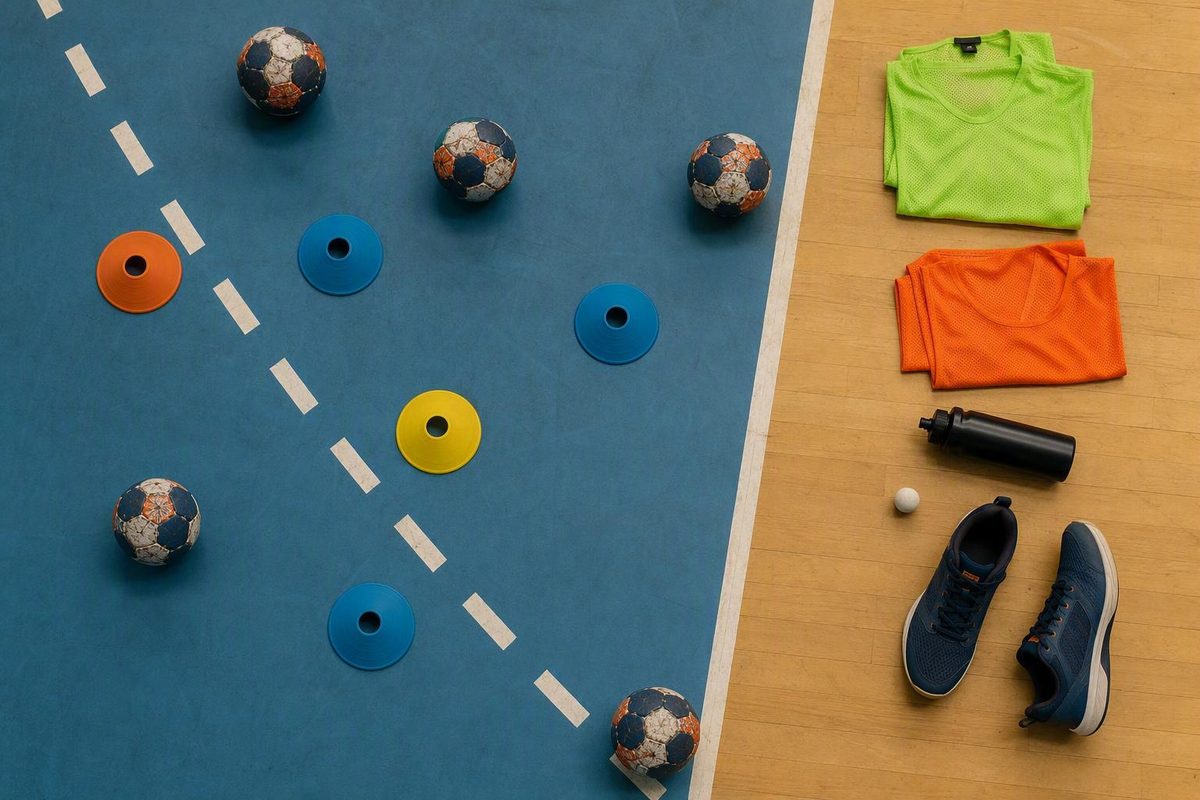
Use this 25-minute progression with 6–10 adolescent or adult beginners and intermediates, half a court, one ball per pair and four cones. It moves from an unopposed technique check to a pass made under defensive pressure.
The passing action
For a right-handed player:
- Hold the ball above and slightly behind the head, with the elbow bent rather than dropped against the ribs.
- Show the left shoulder towards the receiver and keep the feet in a balanced staggered stance.
- Point or reach towards the receiver with the non-throwing arm.
- Transfer weight from the right foot towards the left foot while the hips and torso turn.
- Bring the elbow forwards first; the forearm and wrist follow last and fast.
- Release in front of the head and allow the throwing hand to finish towards the receiver.
Reverse the feet and arms for a left-handed player. This sequence follows the BBC’s upper-pass guidance: weight moves from back foot to front foot as the hips and torso rotate, the elbow leads, and the throwing arm finishes towards the target (BBC Bitesize).
The cue “elbow, hand, target” is usually more useful than “throw harder.” It gives the player three observable checkpoints without asking them to force the shoulder.
1. Pair calibration: 4 minutes
Setup: Pairs stand 4 metres apart. Each pair has one ball. Mark a small receiving window between chest and head height.
Action: Players make six controlled passes each, pause for one correction, then make another six. Ask for a firm pass at roughly 60% effort rather than maximum speed.
Watch for:
- the elbow arriving forwards before the hand;
- the chest turning towards the receiver;
- the throwing hand finishing on the target line;
- a catchable ball arriving in the receiver’s window.
Move the pair closer if the passer leans back or launches the ball. Distance should not dictate poor technique.
2. Step and pass through a gate: 5 minutes
Setup: Keep the same pairs. Place a two-cone gate about 1 metre wide halfway between them.
Action: The passer starts side-on, steps towards the target and sends the ball through the gate. Complete four passes from a static start, four after one approach step and four after receiving while moving.
Constraint: A pass only scores if it travels through the gate and can be caught without the receiver taking more than one adjustment step.
Checkpoint: The step, trunk turn and arm action should form one sequence. If the arm throws before the front foot accepts the weight, slow the player down and remove the approach step.
3. Triangle pass and move: 6 minutes
Setup: Groups of three use a triangle with sides of 5–6 metres. With eight or ten players, use one group of four and rotate the resting player after every pass.
Action: Pass, follow the ball and take the receiver’s place. After one minute, require the receiver to begin moving before the ball arrives. Alternate the direction every 60–90 seconds so players pass from different body orientations.
Coaching priority: Do not let players turn this into a stationary throwing queue. The passer should scan, present a target and release towards the teammate’s path rather than their previous position.
For more ways to extend passing work with restricted numbers, use these handball passing drills for small squads.
4. Add a defender and a decision: 6 minutes
Setup: Make a channel approximately 5 metres long and 3 metres wide. Use groups of three: passer, receiver and defender. Extra players wait behind the passer or receiver and rotate in after each attempt.
Action: The receiver moves to either side of the channel. The defender begins passively, showing one passing lane while closing the other. The passer must select the open side and use the same shoulder-pass sequence without a long wind-up.
Progress the defender from passive to active interception only when passes remain controlled. Award one point for a clean reception and one bonus point when the passer’s hand finishes towards the chosen lane.
Checkpoint: Accuracy must survive the added decision. If players start slinging across their bodies, widen the channel or return the defender to passive movement.
5. Finish with 3v2 keep-ball: 4 minutes
Setup: Play in a 10-by-10-metre area. With six players, run two groups of three and rotate one defender every 30 seconds. With seven to ten, play one 3v2 while the remaining players form the next group.
Action: Attackers score by completing five passes. No dribbling. Change defenders after a turnover or score.
A shoulder pass is not compulsory when a shorter pass is safer. The purpose is to recognise when the technique fits the passing lane, not to use it regardless of pressure. Apply normal possession limits when your group is ready; this handball rules guide covers the steps and seconds that affect the decision.
Fix the fault you can see
| Fault | Likely cause | Immediate adjustment |
|---|---|---|
| Ball flies high | Player leans back or releases late | Bring the target closer; cue “chest forwards” |
| Ball travels across the receiver | Arm sweeps across the body | Use the cone gate; cue “hand to target” |
| Pass lacks pace | No weight transfer or trunk rotation | Return to a staggered stance and one deliberate step |
| Elbow drops beside the ribs | Ball starts too low or is too difficult to grip | Reduce distance and check that the ball size suits the player |
| Technique collapses under pressure | Defender or space constraint was added too early | Make the defender passive or widen the channel |
Stop hard throwing if a player reports shoulder pain. Do not try to correct pain by demanding a bigger arm swing. Keep that player on low-intensity ball work only if it is comfortable, and follow the club’s medical or return-to-play process.
The final standard is simple: balanced approach, elbow leading, quick forearm and wrist, hand finishing towards a teammate who can catch in stride. Once that remains visible against an active defender, the pass is ready to enter a larger positional or transition exercise.