
How to Use Plyo Balls in Handball Training Without Copying a Baseball Routine
A 20-minute plyo-ball block for adult handball players, with loads, progressions, coaching cues and safer alternatives for mixed-level squads.
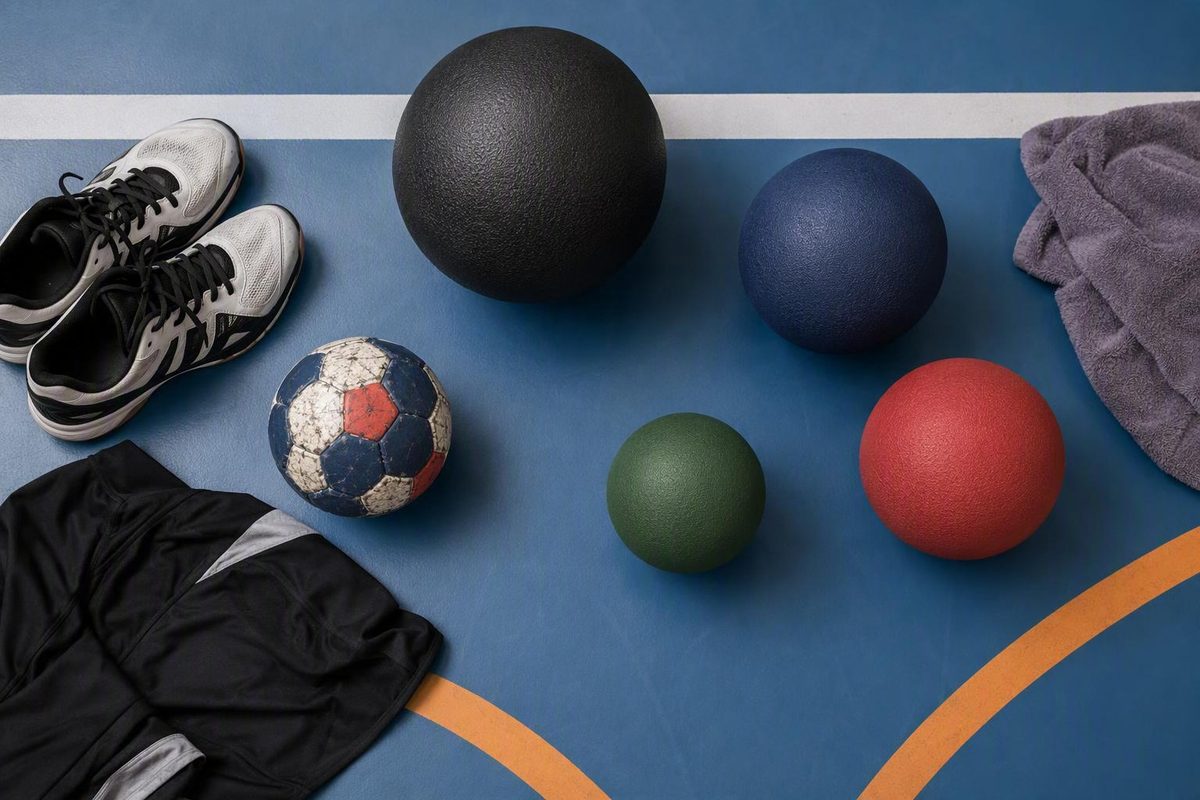
“Plyo ball” usually means a small, pliable, sand-filled weighted ball made for baseball throwing drills—not a regulation handball and not simply another name for a medicine ball. One prominent set ranges from 100 g to 1,000 g, has a baseball-sized 2.85-inch diameter and is intended to deaden on impact during wall or rebounder work (Driveline).
That matters because a baseball routine should not be copied throw for throw into handball. The grip is different, the sport action is different, and changing ball mass changes the throw. In a recent handball biomechanics study, 11 adult male players threw 360 g, 427 g and 1,000 g balls from a seated position. The 1,000 g ball produced lower release speed and higher elbow-extension torque than the lighter balls (BMC Sports Science, Medicine and Rehabilitation). This was a small laboratory study, not an injury trial, but it gives coaches a clear reason not to treat the heaviest ball as a normal handball at maximum effort.
The practical decision
For most club sessions, use the regulation handball for handball technique. Use a plyo ball only as a short, controlled constraint block for experienced, pain-free adult players who already throw regularly.
Do not use it to teach beginners their basic shot. Do not ask players to catch a heavy plyo ball at speed, shoot it at a goalkeeper or copy a maximum-effort baseball velocity routine. Even the baseball manufacturer describes its PlyoCare drills as submaximal warm-up and arm-care work, while its own broader routine varies intensity and volume by training day (Driveline).
For youth players, returners from shoulder or elbow injury, and anyone reporting pain, keep this block to regulation-ball passing or use an exercise selected by a qualified clinician. A proper handball shoulder warm-up has much stronger sport-specific support: an exercise programme covering shoulder rotation, rotator strength, scapular strength, kinetic-chain function and thoracic mobility reduced the prevalence of shoulder problems in a season-long trial involving 660 elite players (Oslo Sports Trauma Research Center). Plyo balls should not replace that work.
20-minute block for 6–12 adult players
Space: Half a hall, with one smooth wall or securely fixed rebounder away from other activity Equipment: One regulation handball per pair; one light plyo ball per working pair; cones Assumption: Experienced adult club players with no current throwing pain Aim: Preserve a connected legs–trunk–arm action while introducing a small change in load—not chase a speed record
If your set includes baseball-sized balls from 100 g to 1,000 g, begin with the ball nearest the mass of the players’ normal handball. Do not begin with the 700 g or 1,000 g ball for one-arm overhead throws. The study above found materially different elbow demands at 1,000 g, and its authors concluded that heavier balls significantly increased elbow-extension torque.
1. General and shoulder warm-up — 6 minutes
Players work in pairs:
- Two minutes of movement: jog, side-step, turn and decelerate.
- Two minutes of controlled regulation-ball passes, beginning at 4–5 m.
- Two minutes of shoulder-preparation exercises already used in the team’s established warm-up.
Checkpoint: Players should be warm and able to pass without pain before the weighted ball appears. “My arm feels heavy” is not a target sensation.
2. Two-hand wall throw — 4 minutes
Stand 2–3 m from the wall in a staggered stance. Hold the plyo ball at chest height, shift pressure from back foot to front foot and make a firm two-hand chest throw into the wall. Retrieve the dead ball from the floor rather than trying to catch it.
Complete 2 sets of 5 throws, changing the lead foot for the second set. Rest while the partner works.
Watch for: trunk and legs starting the action; ribs remaining controlled; no backward lean.
Regress: use the regulation handball. Progress: use a slightly firmer intent, not a heavier ball.
3. Split-stance one-arm wall throw — 5 minutes
Use the light or near-regulation-mass plyo ball. Stand 3–4 m from the wall with the opposite foot forward. Start at roughly 50% effort and throw into the wall with a compact overarm action. The ball is retrieved, not caught.
Complete 2 sets of 4 throws per arm. Rest at least as long as the work takes.
Give only two cues:
- “Push the floor, then turn.”
- “Let the hand finish forward; do not force the follow-through.”
Stop the set if accuracy scatters sharply, the player loses the sequence from legs to trunk to arm, or discomfort appears. Heavier is not automatically more specific: research with experienced handball players has repeatedly found that release velocity falls as ball weight rises (Journal of Sports Science and Medicine).
4. Transfer to handball — 5 minutes
Put the plyo balls away. Each pair makes six advancing passes with a regulation handball, then each player takes four shots after a three-step approach. Keep the first two shots controlled before approaching normal training speed.
Checkpoint: The handball should feel familiar, not merely “light.” Look for the same approach rhythm and body sequence used before the plyo-ball block. If the elbow leads early, the trunk opens too soon or accuracy deteriorates, return to controlled passing.
How to fit it into a club week
Place this block after the general warm-up and before high-volume shooting, contact or a game. Count its one-arm throws as part of the day’s throwing load rather than as free preparation.
Run it with two lanes in a mixed-level squad:
- Experienced lane: light plyo ball, low repetitions, submaximal wall throws.
- Development lane: regulation handball, the same footwork and sequencing cues.
Medicine-ball training does have direct handball evidence, but it should not be confused with proof for every plyo-ball routine. In one randomized study, 21 female handball players averaging about 17 years old completed either regular training or regular training plus a 12-week medicine-ball programme; the added-training group improved more in medicine-ball throw tests and upper-body power measures (PubMed). That supports planned resistance work over time—not an improvised set of maximum-effort heavy throws.
Treat the plyo ball as one constrained tool inside a complete practice. The success check is simple: players complete a small number of pain-free, coordinated throws and then transfer cleanly back to the handball. For the rest of the session, continue with a progression such as these passing drills for small squads or the three-lane mixed-skill practice plan.